
Summary
In When the power is late, who pays? we argued that if the AI build-out cracks, the crack will run through the financing rather than the demand. This paper looks at one part of that financing which has grown very quickly and is not well understood: the chip vendor standing behind its own customers’ debt.
The pattern is now established. In September 2025 Nvidia agreed to buy CoreWeave’s unsold cloud capacity through 2032, an arrangement initially valued at USD 6.3 billion, and took USD 2 billion of CoreWeave equity, with CoreWeave using the proceeds and USD 7.5 billion of GPU-collateralised debt to buy Nvidia chips. In July 2026 Nvidia introduced a backstop model under which it rents back unused GPU capacity from neocloud partners at a fixed rate, underwriting a utilisation floor so that lenders will extend credit. In August it signed memoranda with six financial firms to mobilise more than USD 500 billion for its customers’ infrastructure, with its chief executive saying the company could backstop up to USD 125 billion, a quarter of the total. On 13 October AMD signed a credit support agreement for the first 222-megawatt phase of Fermi’s Texas campus, backing a lease to the GPU cloud TensorWave that still had to close by the end of the month. Broadcom is reported to be raising more than USD 50 billion for the chip it is building with OpenAI, with residual value guarantees in the structure. Oracle is reported to be in talks with Apollo and Goldman Sachs about a separate company that would buy chips and lease them back.
When the tenant is not investment-grade, somebody else’s balance sheet has to stand behind it. For a growing share of AI capacity, that balance sheet belongs to the company that sold the chips. This paper asks what that does to the credit, and what a lender should look for before relying on it.
Figures are as reported on the dates shown. Several come from secondary coverage rather than primary filings and are marked as such. Nothing here is a valuation of any named company.
1 · What vendor support actually is
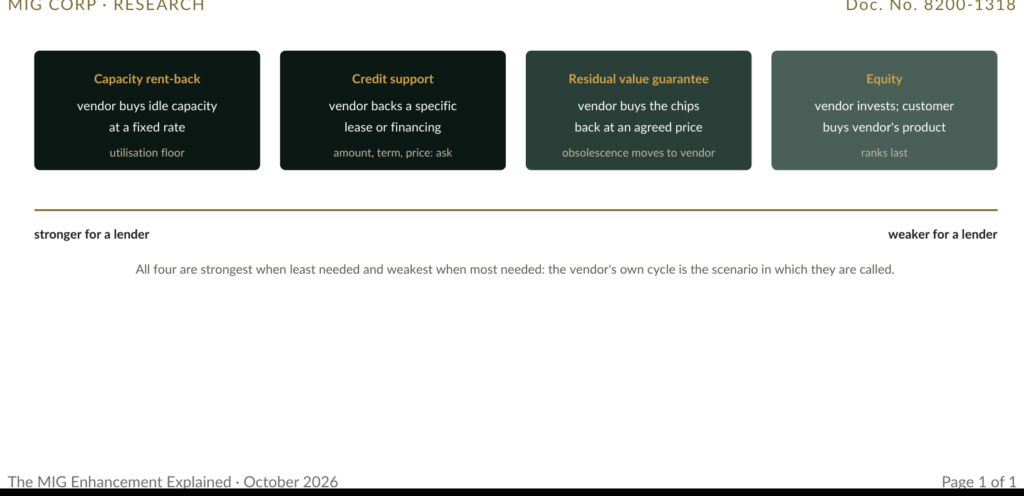
Vendor support comes in four forms, and they are not equally good.
A capacity purchase or rent-back. The vendor agrees to buy the customer’s unsold capacity, or to rent back idle GPUs, at a fixed rate. This is the CoreWeave arrangement and the July 2026 backstop model. It gives the lender a utilisation floor: whatever happens to demand, a stated portion of the fleet earns a stated amount. It is take-or-pay from the vendor’s side.
A credit support agreement. The vendor supports a specific lease or financing, typically by guaranteeing or backstopping payments under it. This is the AMD–Fermi arrangement. The public release gives neither the amount, the term nor the price of the support, which is itself the first thing a lender would want to know.
A residual value guarantee. The vendor guarantees the value of the chips at the end of the lease, so that the lessor’s exposure to obsolescence is capped. This is reported in the Broadcom structure. It addresses the single largest risk in GPU finance, which is that a chip bought in 2026 is worth very little by 2030, and it moves that risk onto the vendor.
Equity and circular purchase. The vendor invests in the customer, which uses the money to buy the vendor’s product. Nvidia’s stakes in CoreWeave and, as reported, Nebius are the examples. This is the weakest form of support for a lender, because it is equity, which ranks last, and because it is the arrangement that has attracted the word “circular”.
2 · Why vendors are doing it
The commercial logic is not complicated. Lenders to neoclouds and to AI campuses want an offtake contract or a backstop from an investment-grade counterparty before they will fund. The hyperscalers can provide that for their own capacity. The neoclouds and the single-site developers cannot. If the vendor wants those customers to keep buying, it has to make them financeable, and the cheapest way to do that is to lend them its own rating.
For the vendor the exposure is, on its own account, manageable. A capacity rent-back is an operating commitment that only bites if demand falls. A credit support agreement on one phase of one campus is small against the vendor’s balance sheet. The residual value guarantee is the one that can hurt, because it is a bet on the vendor’s own product cycle, and the reported refusal of one chief financial officer to cap it is worth noting.
For the market the exposure is different, because it is aggregated. One analysis puts Broadcom’s reported exposure at USD 30 billion of a USD 35 billion stack, against a stated ceiling of 25% for Nvidia; we have not been able to confirm those figures against primary documents and give them for what they are. What can be said with confidence is that the vendors’ own credit is now part of the collateral behind a meaningful share of AI debt, and that their credit default swaps, Oracle’s and Broadcom’s at highs not seen since 2009 as of early October, are moving with the same news that moves their customers.
3 · Wrong-way risk, again
In When the power is late we described wrong-way risk at Project Jupiter: the event that delays the project, late power, also weakens the party the lender relies on, Oracle. Vendor support has the same shape.
A lender relying on Nvidia’s capacity backstop is relying on Nvidia’s willingness and ability to keep paying for idle GPUs. The scenario in which that backstop is called, a fall in demand for GPU capacity, is the scenario in which Nvidia’s own revenue falls, its share price falls, and its appetite for honouring open-ended operating commitments is tested. The scenario in which a residual value guarantee is called, chips worth less than expected, is the scenario in which the vendor’s next product has disappointed or the market has turned. The support is strongest when it is least needed and weakest when it is most needed. That is the definition of wrong-way risk, and it is why we discount vendor support rather than treat it as a substitute for an investment-grade offtaker.
The circularity point is related but distinct. If a vendor invests in a customer, the customer buys the vendor’s chips, and the vendor then backstops the customer’s debt, then one balance sheet is carrying the demand, the supply and the credit. That is not necessarily unsafe. It is concentrated, and concentration is what rating agencies and lenders are paid to notice.
4 · What the market is already doing
The market has started to price the difference between tenants, and the numbers are instructive.
Lambda closed a USD 1 billion delayed-draw term loan at 6.78% fixed, rated A (low) and Baa1, backed by contracted cash flows from two investment-grade customers, with money released only as each cluster was commissioned. In the same month Volta’s unrated USD 5 billion six-year GPU loan was offered at a margin of more than six percentage points over the benchmark and at a discount, for a yield in the low double digits. Similar collateral, different payer, a gap of four to five points. CoreWeave’s own facilities show the same thing in one borrower: a delayed-draw loan with an investment-grade rating, described as the first of its kind, alongside a later facility whose five-year maturity sits against customer contracts averaging about three years.
Two features of these deals point the way. Delayed draw, so that money is advanced only as capacity is commissioned and contracted, is now the market’s answer to construction and power-delay risk. And a term matched to the customer contracts, rather than to the useful life the sponsor hopes the chips will have, is the market’s answer to residual value risk. Where vendor support exists, it belongs on top of those two features, not in place of them.
5 · What we would want before relying on vendor support
We are not lenders to neoclouds. We finance power, and increasingly the power behind compute, and the compute tenant’s credit is therefore our credit at one remove. When a tenant’s bankability depends on vendor support, these are the questions we would want answered.
What form does the support take, and does it rank as debt, as an operating commitment, or as equity? A capacity rent-back or a credit support agreement can be lent against; an equity stake cannot.
What is the amount, the term and the price? If the public announcement does not say, the lender’s documents must. Support whose size is undisclosed is support whose size is unknown.
What triggers it, and can the vendor walk away? An operating commitment with termination rights is weaker than a guarantee without them.
Does the support outlast the debt? Vendor commitments through 2032 are of limited use against a loan maturing in 2034.
What is the vendor’s own credit, and how does it move with the scenario in which the support is called? This is the wrong-way question, and it should be answered with the vendor’s credit default swap in front of you, not its share price.
How much of the vendor’s total support is already committed elsewhere? A backstop ceiling of a quarter of half a trillion dollars is a large number; what matters is how much of it is already promised.
And finally, is the power contract itself separable from the compute credit? Where we finance the power, we want a capacity payment from the day power is available, payment security from the tenant or its sponsor, and the right to re-let the power to the next tenant if the first one fails. Vendor support for the tenant is welcome. It does not replace any of that.
6 · The bottom line
Vendor support has made a great deal of AI capacity financeable that would not otherwise have been, and it will go on doing so. It is also a transfer of credit risk onto a small number of balance sheets whose fortunes move with the same cycle as the assets they support, and the market has not yet seen that cycle turn. A lender who treats a chip vendor’s backstop as equivalent to an investment-grade offtaker is making a bet on the vendor’s balance sheet in the one scenario in which that balance sheet is under pressure. We would rather lend against the power, with a term matched to the contract and a draw schedule matched to the asset, and treat the vendor’s support as what it is: useful, conditional, and somebody else’s promise.
Sources
CoreWeave, Form 8-K, 15 September 2025 (Nvidia capacity purchase order form and equity investment): sec.gov
Data Center Dynamics, “Nvidia acts as backstop for customer GPUs in return for cut of cloud revenue”, 2 July 2026
Capacity, “CoreWeave’s debt hits USD 35bn: what it means for the neocloud refinancing wall”, 2026 (secondary)
CNBC, “Nvidia, Wall Street asset managers partner on USD 500B AI push”, 10 August 2026; Yahoo Finance / Reuters coverage of the same announcement; Nvidia chief executive’s statement on X regarding a USD 125 billion backstop option (as reported)
Fermi, “Fermi signs credit support agreement with AMD and announces partnership”, 13 October 2026 (Access Newswire); Data Center Dynamics and Blockspace coverage
24/7 Wall St., “Broadcom vs. Oracle: whose AI chip debt financing scheme looks worse?”, 12 October 2026 (secondary; exposure figures unconfirmed)
Yahoo Finance / Bloomberg, “SpaceX, Broadcom and Oracle all want billions in AI chip debt at the same time”, October 2026
TIKR, “Oracle courts Apollo and Goldman for AI chip financing as debt tops USD 169 billion”, October 2026 (secondary)
IFR, “Hyperscaler and chipmaker CDS widen to record levels”, 10 October 2026
Lambda, “Lambda closes USD 1 billion senior secured fixed rate financing”, 1 October 2026; PitchBook on Volta’s USD 5 billion loan, October 2026
MIG Corp, When the power is late, who pays? (8200-1319), October 2026
MIG Corp publishes research on the structuring and financing of emerging-market infrastructure. Related papers: The MIG Enhancement Explained (8200-1318); When the power is late, who pays? (8200-1319); MIGCorp Bond one-pager (8200-1313); Financing AI Data-Centre Power (8200-1312); Floating LNG-to-Power for AI Data Centres (8200-1311). Further information on specific transactions is available under NDA from investments@mig-corp.com.
This paper is for information only and does not constitute an offer or solicitation. MIG International Ltd — RAK ICC Reg. No. A002/09/12/5254 — investments@mig-corp.com · mig-corp.com
The MIGCorp Bond™ is not a corporate bond of MIG International Ltd, is not a fund, and is not an offer of securities to the public. Each issuance is separately documented and separately rated, and is made available only to qualified institutional and professional counterparties. An investment-grade rating is sought for the issuing vehicle of each transaction; whether it is obtained, and at what level, depends on the structure, the credit profile and the agency’s own assessment. No rating is guaranteed. Worked examples are illustrative and do not describe any specific transaction or counterparty.
© 2026 MIG International Ltd. This paper may be quoted and shared with attribution and a link to mig-corp.com; it may not be sold or altered.