Figures are as reported on the dates shown. Numbers labelled “MIG illustrative model” or “own maths” are MIG calculations, not published data.
Executive summary
A data centre can be built in one to two years; the power to run it can take five to ten. That gap is now the most important risk in AI data-centre credit. Someone has to pay for the months when the building is finished, the chips are installed and the debt is drawn, but the electricity has not arrived.
If the AI build-out cracks, it won’t be because nobody wants AI: memory is sold out, rental prices for the newest chips are rising, and hyperscalers are paying cash up front for power plants. The bubble, if there is one, is in the financing, not the demand. Thin equity, debt whose term doesn’t match the contract behind it, and projects whose power turns up late break first, and rising rates make each weakness dearer every month. On MIG’s illustrative model, 100 MW of facility and GPUs that sit built but unpowered for 12 months carry a cost of about $1.1bn, roughly 12 times a full year’s power bill. Late power is far more expensive than costly power.
The live case is Oracle’s Project Jupiter in New Mexico. Its gas pipeline has slipped from August 2026 to an estimated February 2027, Oracle has sent a force majeure notice to the developer, about $18bn of bank loans were quoted at 89–91 cents on the dollar in September, and Oracle’s own default insurance has reached its highest level since at least 2009. Jupiter shows that a contract can move the timing of a loss between tenant, owner and lender, but it cannot make the loss disappear.
The answer is to finance AI infrastructure the way disciplined players do. Brookfield’s rulebook, which MIG follows: no building on spec, take-or-pay contracts with investment-grade customers, contract term matched to the debt, little residual value assumed, non-recourse project-level debt, and power secured first. Hyperscalers are accepting this logic (Google advanced $399m for long-lead equipment in Wyoming), and lawmakers are writing “the data centre pays for the power it causes” into law. The winners will sell speed to power and certainty, not cheap electricity. That is the market MIG is building for, with floating power and floating data centres offered as one package.
Key findings
Power, not chips or buildings, sets the pace. Morgan Stanley sees a 32 GW US net power shortfall through 2028 (about 34% of need) even after on-site generation; UBS (as reported) puts 2027 need at 57 GW against 38 GW of sites with confirmed power.
Late power costs far more than expensive power. On MIG’s illustrative model, a 12-month delay on 100 MW costs about $1.11bn of carry, roughly 12 times a year’s power bill. The GPU tenant bears about 90%.
Force majeure moves the timing of a loss; it does not cancel it. At Jupiter, Oracle reportedly can’t terminate and pays the debt costs, but the owner waits longer for full rent and the loans were quoted at 89–91 cents in September.
Execution risk and counterparty risk are becoming one risk. Jupiter’s lenders rely on Oracle, whose 5-year CDS hit 257bp on 8 October (IFR), one notch above junk at S&P.
Behind-the-meter power moves schedule risk; it doesn’t remove it. Jupiter left the grid queue and joined the gas-pipeline queue, with trucked gas at about four times pipeline cost as the stopgap.
Customers are starting to pay for the plant. Google’s $399m refundable equipment advance in Wyoming, Oracle’s ~$300m at Point Beach and Indiana’s 80% cost-causer rule push delay risk onto the strongest party.
Construction lending is the early warning light. Oracle’s record $38bn construction loan was still being sold down at a discount six months on.
Discipline works. Brookfield’s Strängnäs campus has stalled on grid power, but we found no Brookfield debt under stress: a building problem, not a financing problem.
1. The financing bubble, not the demand bubble
On 7 October 2026, at the Forbes Global CEO Conference in Singapore, Ray Dalio called AI “a classic bubble”. His reasoning was about money, not technology. Much of the build-out is financed with debt. When interest rates rise, holders of assets have to sell some of them to turn paper wealth into cash to service that debt, and that is when bubbles pop. Asked about timing, he said: “I think we’re close to that.” (Financial Post / Bloomberg; The Business Times)
Dalio is right about the mechanism; the question is where it bites. Demand for AI compute is real. In October the newest Nvidia B300 GPUs were renting for about $9.51 an hour, up from $8.50 a week earlier (FastGPU); Nebius raised its on-demand H100 price from $3.85 to $4.50 on 1 October (GPU Cloud Advisors); and most of Micron’s 2027 high-bandwidth memory is already contracted (Chosun Biz). People who expect demand to disappear are looking at the wrong layer.
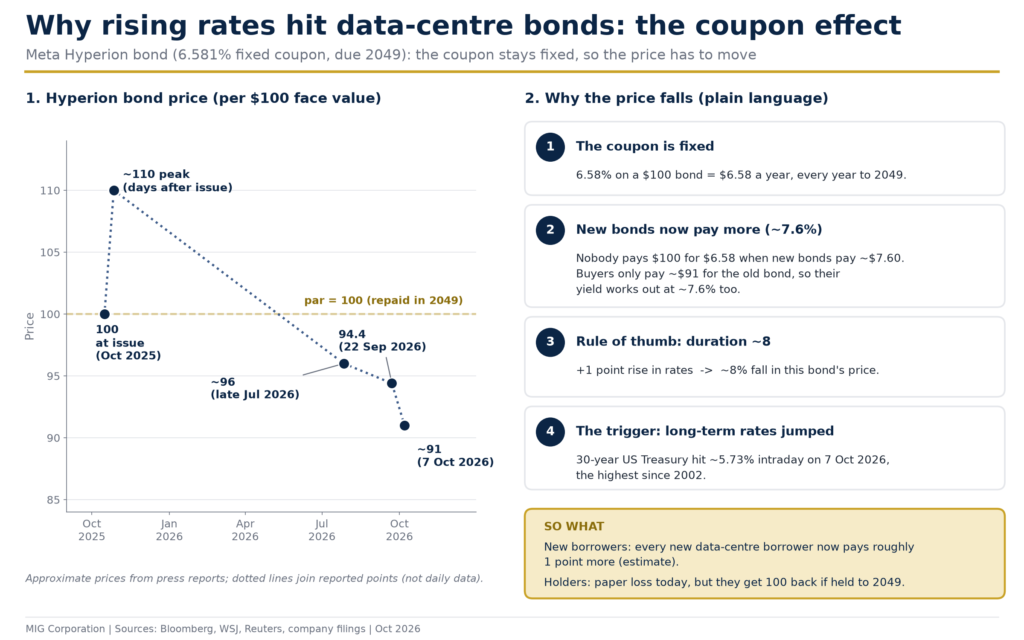
The strain is in the financing. Oracle’s and Broadcom’s credit default swaps are at their highest since at least 2009 (IFR). Meta’s $27.3bn Hyperion bond (6.581% coupon, due 2049, rated A+) has traded at a record low of about 91.6–91.7 cents (GuruFocus). Banks are selling down Oracle’s $38bn construction loan at a discount, and chip vendors are guaranteeing their customers’ debt (the subject of our next paper).
The rate move has been large. The US 10-year Treasury yield was about 3.98% a year ago and closed at 5.24% on Friday 9 October (FRED); the 30-year reached its highest level since 2002 on 7 October (UPI). A delay that was an annoyance at 4% becomes dangerous at 7%.
Figure 1: The coupon effect: why rising rates hit data-centre bonds (MIG Corp)
Hyperion also shows the second weakness, mismatched term: a 23-year bond on a four-year initial lease, supported by Meta’s residual value guarantee. That is the opposite of the “matched term” rule, and when power is late the clock on the debt keeps running while the clock on the revenue hasn’t started.
Our thesis, in one line: if the AI build-out cracks, the crack will run through the financing, and late power is where thin equity and mismatched debt break first.
2. Lead case: Oracle’s Project Jupiter
Project Jupiter is a 1,400-acre campus in Doña Ana County, New Mexico, built for Oracle’s computing contract with OpenAI under Stargate; Oracle has told regulators it represents an investment of up to $165bn (Bloomberg via Energy Connects). It is meant to run on up to 2.5 GW of Bloom Energy gas fuel cells, and those fuel cells need gas.
The pipeline slip
The gas is supposed to arrive through Energy Transfer’s Green Chile project: about 17.8 miles of 24-inch pipeline able to deliver up to 400,000 dekatherms a day to the campus (Federal Register). In August, Energy Transfer’s subsidiary Transwestern moved the estimated in-service date from 15 August 2026 to 1 February 2027 (Source NM; Bloomberg via Energy Connects). Even that date may be optimistic: an Energy Aspects analyst told Bloomberg he expects service “in the second half of 2027 at the earliest”, with a risk of cancellation if progress stalls. FERC issued its environmental assessment on 4 September and set a federal authorisation deadline of 3 December 2026.
On 13 October Oracle wrote to FERC again. “Time remains of the essence,” its senior vice president of government affairs wrote, warning that further delay “threatens to delay Project Jupiter’s operations” (Bloomberg Law). Oracle publicly says the project “remains on our planned schedule”. For lenders, the point is that the schedule now depends on a regulator and a pipeline company, not on the tenant or the developer.
The stopgap: trucked gas
Bloomberg reports that Oracle has trucked compressed natural gas to AI sites in Salt Lake City and Texas, at about four times the cost of pipeline gas, and is weighing the same for Jupiter (Business Insider / Bloomberg). Trucked gas buys time, but the public record doesn’t say who carries the premium. Every lender should ask that question in its own deals.
Force majeure: who actually pays
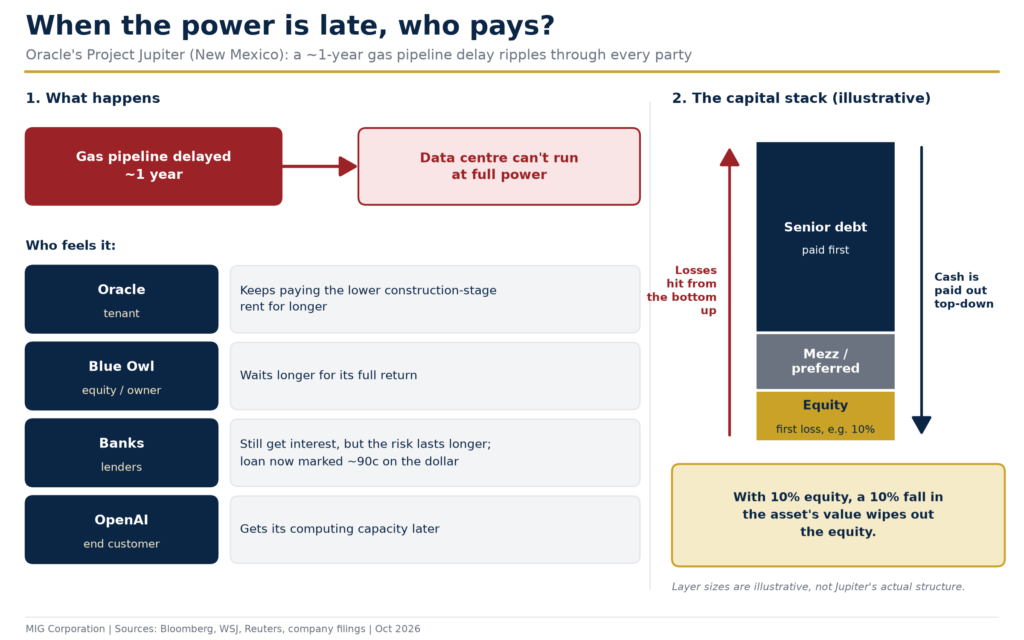
On 24 September Oracle sent a force majeure notice to the developer, a unit of Blue Owl, over potential power delays (Reuters via BNN Bloomberg).
The details Reuters reported show how even a well-protected lease spreads pain:
Oracle cannot terminate the lease under any circumstances, and Oracle is responsible for paying the debt costs. Securing power is Oracle’s responsibility under the contract.
Blue Owl has about $3bn of equity, earning about 9% during development and expecting about 11% levered on completion. Force majeure extends the period of lower development-stage rent; Blue Owl still gets the higher rent for the full term, but later.
The banks, about 20 of them, lent about $18bn. They keep getting interest, but their risk lasts longer and their loans have been marked down: in mid-September the FT reported quotes of 89–91 cents on the dollar from syndicate banks including Santander and Jefferies, with efforts to sell the debt more widely stalled (Reuters / FT, 18 Sep). Later secondary reports cite indications in the mid-80s; we could not confirm those from a primary source.
OpenAI, the end customer, gets its computing capacity later.
Figure 2: When the power is late, who pays? Project Jupiter and the capital stack (MIG Corp; delay length and layer sizes illustrative: the official pipeline slip is about 5.5 months, and analysts see risk of a longer one)
So who pays? Everyone, in different currencies. Oracle pays in carry and credit standing. Blue Owl pays in time: the same rent received later is worth less. The banks pay in mark-to-market losses if they sell and longer exposure if they hold. Nothing is “lost” in the accounting sense yet, which is why this kind of stress is easy to underestimate.
Execution risk meets counterparty risk
The deepest lesson of Jupiter is that the lender’s protection is Oracle, and Oracle’s credit is weakening as the project slips. Its 5-year CDS reached 257bp on 8 October, the highest since at least 2009 and up from 182bp in mid-September (IFR). Its 4.95% notes due 2031 yielded about 6.72% on 6 October (BondTerminal); about $39.9bn of its debt falls due by May 2031 (Oracle 10-K, FY2026); and S&P rates it one notch above junk after a July downgrade (Reuters).
In normal project finance, “will it get built?” and “will the customer pay?” are separate questions. In AI data centres today they are increasingly the same question, because the customers’ own credit depends on the build-out succeeding.
3. How big is the power gap?
Morgan Stanley estimates a US net power shortfall for data centres of about 32 GW through 2028, roughly 34% of what developers need, even after counting on-site generation and fuel cells (Reuters via Investing.com, 5 Oct). Before those fixes, the gap is 57 GW. The bank raised its estimate of US data-centre power demand for 2026–28 from 68 GW to 97 GW, largely because new rack-scale systems draw far more absolute power even as they do more work per watt (Blockspace).
UBS reaches a similar conclusion from a different angle. As reported by Crypto Briefing, UBS sees 57 GW of data-centre capacity needed in 2027 against only 38 GW of sites with confirmed power, a gap of about 19 GW, or a third of need (own maths) (Crypto Briefing on UBS, 12 Oct). UBS expects adequate power by 2030, provided early projects come online as scheduled. That proviso is the subject of this paper.
Gas turbines, the default answer for fast firm power, are sold out. Wood Mackenzie forecasts turbine prices of about $600/kW by end-2027, up 195% since 2019, with about 110 GW of orders at end-2025 against 60–70 GW a year of factory capacity, lead times of about six years, and order books sold through 2027 (Wood Mackenzie, 1 Apr 2026). (That turbine figure is Wood Mackenzie’s, not Lazard’s.)
The cost of new power is rising across every technology. Lazard’s 2026 Levelized Cost of Energy+ finds new gas combined-cycle averaging 9.0¢/kWh, a 15-year high and up about 15% in a year, with turbine shortages stretching timelines “well beyond historical norms” (Lazard LCOE+ v19.0, July 2026, pp. 4, 7, 13).
| Technology (US, unsubsidised new build) | LCOE, ¢/kWh | Lazard page |
|---|---|---|
| Onshore wind | 3.7–9.9 | p.7 |
| Utility-scale solar | 4.0–9.8 | p.7 |
| Gas combined cycle | 5.1–12.9 (average 9.0, a 15-year high) | pp.7, 13 |
| Combined cycle at today’s quoted plant costs ($2,400–2,600/kW) | ~10.7 | p.7 note 9 |
| Gas peaking | 14.4–27.6 | p.7 |
| New nuclear (Vogtle-based) | 17.5–25.5 | p.7 |
| Small modular reactor (illustrative, 2030+) | ~21.4 | p.7 note 8 |
| Nuclear restart (illustrative) | ~7.1 | p.7 note 7 |
| Existing combined cycle, running cost | ~4.2 | p.7 note 6 |
Source: Lazard LCOE+ v19.0 (July 2026). Base case: 60% debt at 8%, 40% equity at 12%, US gas at $3.45/MMBtu.
Rates matter here too: at a 10% rather than 7.7% cost of capital, average combined-cycle cost rises from 9.0¢ to 10.5¢ and nuclear from 21.5¢ to 29.1¢ (p.11). Capital-heavy power is the most rate-sensitive.
What does this mean for an AI tenant? On MIG’s illustrative model (Section 4), a GPU operator still earns a 15% return on equity at up to about 19¢/kWh, above almost every new-build technology in the table. Price isn’t the binding limit. Time is.
4. What a 12-month delay costs (MIG illustrative model)
To put a number on time, we used MIG’s unit-economics model (Oct 2026). The base case is a fleet of Nvidia GB300 NVL72 systems on a three-year contract at $3.70 per GPU-hour, with 95% of hours billed. That works out at about $14.4m of compute revenue per MW per year, or about $1.60 of revenue for every kWh the fleet consumes. At a 10¢/kWh power price, electricity is only about 6% of revenue. These are MIG illustrative figures; assumptions are available on request to investments@mig-corp.com.
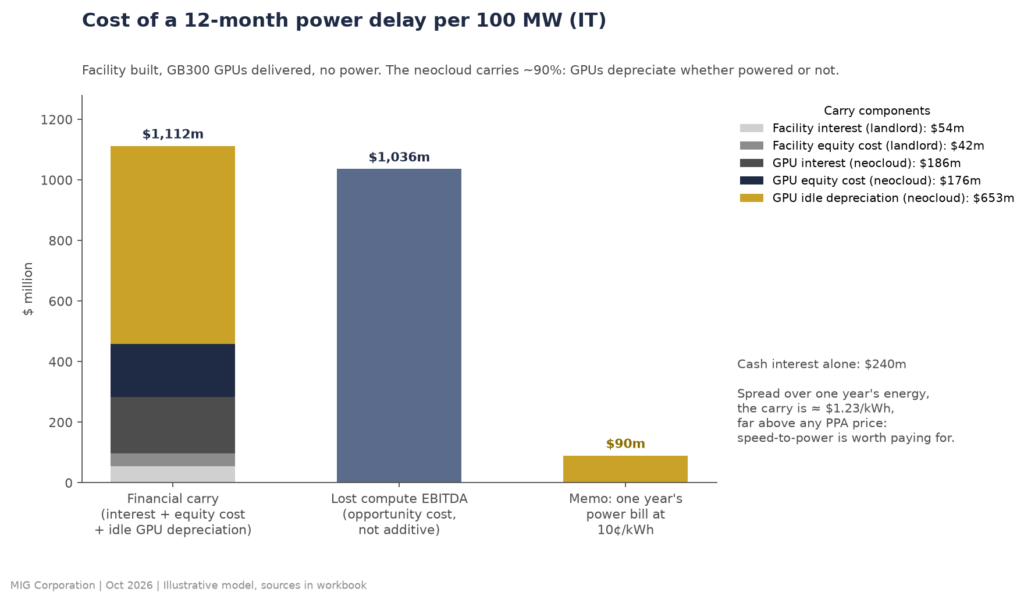
Now take 100 MW of facility and GPUs, built and installed, with no power for 12 months:
| Carry component (12 months, 100 MW) | Who bears it | $m |
|---|---|---|
| Facility interest | Landlord | 54 |
| Facility equity cost (required return) | Landlord | 42 |
| GPU interest | GPU operator (neocloud) | 186 |
| GPU equity cost (required return) | GPU operator | 176 |
| GPU depreciation while idle | GPU operator | 653 |
| Total financial carry | ~1,112 | |
| Memo: one year’s power bill at 10¢/kWh | 90 | |
| Memo: lost compute EBITDA (opportunity cost, not additive) | 1,036 |
Source: MIG illustrative model, own maths.
Figure 3: Cost of a 12-month power delay per 100 MW (MIG illustrative model)
Four things stand out.
First, cash interest is the smaller part, about $240m. The rest is the return equity was promised and, above all, GPUs losing value while they sit dark: a 2026 chip waiting for 2027 power will compete against 2027 chips.
Second, the GPU tenant carries about 90% (about $1.0bn), and the landlord about $96m. That is why the landlord-and-power layer is the safer place to lend, and why the tenant’s balance sheet is the real credit question.
Third, per MW it is about $0.93m a month, roughly 12 times a full year’s power bill. Spread over a year’s consumption, the carry equals about $1.2 per kWh, many times any PPA price on Lazard’s table.
Fourth, late power is far more expensive than costly power. Saving 12 months on a 100 MW site saves the tenant roughly $1bn of carry. That is the economic case for “bring your own power” and for MIG’s floating power: we sell speed and certainty, not cheapness.
The model is illustrative, not a forecast for any named project, and its results move most with GPU rental prices, utilisation and chip life (see Risks).
5. Who pays? What real contracts say
The past few weeks have produced an unusually clear set of real contracts, ranging from “the customer pays for everything” to “nobody has signed yet”.
| Case | How the delay or unused-power risk is allocated | Source |
|---|---|---|
| Google – Black Hills, Cheyenne, Wyoming | Terms to 2048. Google provided $399m of refundable advances for long-lead equipment (to be reimbursed by 30 June 2027). Black Hills invests $1.8bn in 2027–29 for 564 MW of new gas, within a ~2.7 GW resource mix incl. reserves. Protections cover stranded assets, early termination and unexpected costs. The customer pays for the plant. | Black Hills release; Power Engineering |
| Amazon – Homer City, Pennsylvania | 36-building AWS campus powered by a 4.5 GW gas plant financed by Knighthead Capital, online 2028; campus phases run to June 2036. Amazon is the buyer, not the owner; a land plan is not a signed PPA. Timing gap: who pays for power ready before the buildings fill? | The Inference |
| Indiana – AES / Google, 390 MW | First case under a state law making large users cover 80% of the costs they cause. Consumer groups still contest about $74m of grid upgrades charged to ordinary customers. | WFYI, 12 Oct |
| Oracle – Point Beach, Wisconsin | Oracle takes 125–250 MW of nuclear output and absorbs about $300m of rising costs that would otherwise fall on local customers. | NEI Magazine; WPR |
| Google – Constellation | A 20-year PPA funds $4.3bn of uprates adding 890 MW at 11 reactors; first in 2028, all by 2032. The open items are regulatory: NRC approval and PJM’s “bring your own capacity” ruling. | Google; POWER |
| NRG vs AWS–Vistra, Texas (1.2 GW each) | NRG: proposed new gas build for an unnamed hyperscaler, terms only, first phase late 2029, >95% of cash from capacity payments. AWS–Vistra: signed 20-year PPA from existing Comanche Peak nuclear, from Q4 2027. Same MW, very different risk. | The Compute Wire |
| JERA, Chiba (Japan) | Up to 400 MW straight from an existing plant, 15–25-year deal, no normal grid connection. Plant-next-door logic, as with floating power. | JERA |
| Wärtsilä, 282 MW on-site engines (US) | Developer builds its own power because the grid is too slow; delivery 2028. | Wärtsilä |
Three patterns stand out.
The strongest customers are paying for certainty. Google’s Wyoming structure is the template: the customer funds long-lead equipment, protects the utility against stranded assets, and bears the cost of serving its load. The headline works out at about $3,190 per kW (own maths: $1.8bn ÷ 564 MW), above Lazard’s assumed $1,450–2,100/kW for new combined cycle and the $2,400–2,600/kW quotes it cites, although the headline may include more than the plant. Given what a delay costs, paying up is rational.
Existing assets beat new ones. AWS–Vistra, JERA and Google–Constellation all lower construction risk: a new plant has to be built on time; an existing one only has to be connected.
Risk hides between “announced” and “contracted”. Homer City and NRG’s Texas plant are credible, but neither yet shows the full chain of signed contracts a non-recourse lender needs. Until then, someone is carrying a timing gap without being paid for it.
A preview of our next paper: on 13 October Fermi said AMD had agreed to provide credit support for the first 222 MW phase of its Texas campus, matching its lease with the GPU cloud TensorWave, which still has to close by 31 October (Fermi). When the tenant isn’t investment-grade, someone else’s balance sheet has to stand behind it; When the vendor is the lender (30 October) examines that.
6. Policy: making data centres pay for their power
Regulation is moving in the same direction as the best contracts: whoever causes the load pays.
US Senate bipartisan energy package: large data centres (20 MW and above) would pay the incremental generation and grid costs they cause, keep paying if they leave early, and utilities could demand financial guarantees before building for them. The package also aims to speed up energy permitting (Axios, 8 Oct).
Indiana’s 80% rule has now been applied for the first time (AES / Google, above).
Utility-level contracts are already doing this privately: Black Hills says Google bears the costs of serving its project without shifting them to existing retail customers (Black Hills / SEC filing).
For a power lender this is good if the tenant is strong: it pushes delay and stranded-asset risk onto the best-capitalised party in the chain. Weak tenants will be asked for guarantees they cannot give.
The grid can still reach you. On 12 October the US Energy Secretary issued Order No. 202-26-50, allowing PJM to direct large loads, including data centres, onto their on-site backup generation as a last resort during an energy emergency, for 13–16 October (IBTimes UK). Even grid-connected load can be told to run its own fuel, so backup fuel logistics and emissions permits are now part of the credit story.
Local consent is part of “power is late” too. In Visakhapatnam, residents are resisting Google’s $15bn hub over water and power, and a Finnish authority has paused two Google sites for environmental review (AFP via Manila Times). At Jupiter, Reuters notes legal challenges over water and air-quality permits alongside the pipeline. Permits are a schedule risk, and schedule risk is a credit risk.
7. The construction-loan market is flashing amber
The market where these risks are priced first is construction lending.
Six months after it was arranged, banks still hadn’t fully sold Oracle’s record $38bn construction loan for sites in Texas and Wisconsin leased to Oracle for OpenAI’s Stargate. Less than $1bn remained, but some lenders were selling pieces to non-banks at a discount to move them; the loan pays about 2.5 percentage points over its benchmark rate (AI Weekly, summarising Bloomberg). With Jupiter’s $18bn quoted at 89–91 in September, the picture is clear: banks underwrote these loans to sell them, and selling now costs money.
Pricing now depends sharply on who pays, not on what is being financed. Lambda closed a $1.008bn delayed-draw term loan at 6.78% fixed, rated A (low) by Morningstar DBRS and Baa1 by Moody’s, backed by contracted cash flows from two investment-grade customers, with money released only as each GPU cluster is commissioned (Lambda, 1 Oct). In the same month, Volta’s unrated ~$5bn six-year GPU loan was offered at SOFR + 6.25–6.50% and 97–98 cents, for an expected yield of 11.2–11.75% (PitchBook). Commitments were due on 14 October, and the outcome is worth watching. Similar collateral, different payer: a gap of about 4.4–5 percentage points (own maths).
Lambda’s structure also answers part of this paper’s question. With delayed-draw debt, money is drawn only as each cluster is switched on, so late power delays the draw instead of running up interest on idle assets.
8. The counter-example: Brookfield’s discipline
Brookfield shows the alternative. Its approach, set out at its 29 September 2026 Investor Day (transcript) and on its Q2 2026 call (BAM), is the rulebook MIG follows:
No building on spec. Nothing is built without a signed long-term contract.
Take-or-pay with investment-grade offtakers. The customer pays for the capacity whether it uses it or not, and is strong enough to keep paying.
Contract term matched to the debt. The first contract alone repays the capital plus a return.
Little residual value assumed. The model gives the asset little or no value at the end.
Non-recourse, asset-level debt. About 87% of Brookfield Renewable’s borrowing is at the asset level (own maths from Brookfield’s reports).
Power secured. “Bring your own power”; don’t wait for the grid.
Brookfield’s deal flow shows the rulebook in action: a $10bn AI Infrastructure Fund with Nvidia and the Kuwait Investment Authority targeting up to $100bn of assets (Brookfield); up to $25bn of Bloom Energy fuel cells on 10–15-year investment-grade contracts (Bloom); a Google hydro framework of up to 3 GW, with the first 670 MW on 20-year contracts worth more than $3bn (Brookfield); and a $20bn partnership with Qatar’s Qai (QIA).
Even Brookfield is not immune to late power. Its roughly $10bn campus at Strängnäs, Sweden, has stalled because grid power isn’t secured (SVT). But when we checked on 8 October, we found no Brookfield bond or loan under stress. Strängnäs is a building problem, not a financing problem, because Brookfield didn’t build on spec and didn’t borrow against a timeline it couldn’t control. Late power is inevitable somewhere; whether it becomes a credit event depends on the structure.
The next test is in Asia: Brookfield and Naver are seeking up to $9bn of debt for a 200 MW campus in Sejong, and Korean lenders are reportedly wary of GPU utilisation and residual values (Korea Herald).
9. The Gulf and the UAE
The Gulf starts with an advantage much of the US lacks: low-cost power and infrastructure. S&P expects Gulf data-centre capacity to roughly triple to more than 3 GW in five years on the back of low-cost power and infrastructure; Saudi Arabia’s Humain alone, at 1.9 GW, could use about 6% of the kingdom’s electricity (S&P via Reuters / TradingView, 12 Oct). Build costs are about $11m per MW in the UAE and about $13m per MW in Saudi Arabia (451 Research via Khaleej Times).
But the Gulf adds a risk the US mostly doesn’t have: physical security. AWS data centres in the UAE and Bahrain were damaged in drone strikes in March, and CNBC reported in September that AWS had still not fully restored service six months later, with some data unrecoverable (CNBC, 15 Sep). In response, G42 is reportedly redesigning the 5 GW UAE–US campus into a network of hardened sites, while the first 1 GW Stargate UAE phase continues (Reuters, 11 Sep).
In the Gulf, then, power can be late because a site has to be moved, split or hardened, not only because a pipeline slips. Three implications follow:
Multi-site designs need power at each site, multiplying the grid connections and fuel supplies that must arrive on time.
Relocatable power gains value when fixed sites carry physical risk. Floating power is relocatable by design, though at-sea assets carry their own war-risk insurance cost, which lenders must price.
Sovereign-linked offtakers change the counterparty question. The strongest Gulf offtaker is often state-linked rather than a rated hyperscaler; lenders need to know exactly which entity signs and what stands behind it.
This is where MIG is distinctive. MIG works on floating power — floating LNG-to-power with our portfolio company Blue Sea Power — and on floating data centres, the compute platform that sits next to that power. Together they answer two questions this paper keeps returning to: when does the power arrive (when the vessel is moored, not when the grid queue clears), and can the asset move if the site becomes unsafe or the customer changes. The fuel and cost build of floating LNG-to-power is covered in our paper Floating LNG-to-Power for AI Data Centres with Blue Sea Power, and the lending structure in Financing AI Data-Centre Power; we don’t repeat either here.
10. Technical depth: why power is late
The building is fast. UBS notes a data centre can go up in 12 to 24 months, while new power capacity can take five to ten years (Crypto Briefing on UBS). Shells and racks are repeatable work; generation and transmission are bespoke, permitted and queued.
The grid queue is long. UBS, as reported, puts US interconnection queues at about 2.3 TW, roughly double the country’s installed capacity as of 2024, with a median of about six years from request to commercial operation (same source).
Heavy equipment is the choke point.
Gas turbines: about six-year lead times, order books sold through 2027, and turbines making up 20–30% of combined-cycle project cost (Wood Mackenzie). The engines that make up the “fast” alternative are themselves on allocation.
Large power transformers: lead times of up to about 210 weeks, around four years (UBS, as reported). A campus can be fully built and still wait on the transformer that connects it to the substation.
Rack density makes it worse. Morgan Stanley’s upgrade is a Jevons story (when something gets cheaper to use, people use far more of it): AI compute is getting far cheaper per unit of output, but the new rack-scale architectures draw so much more absolute power that the bottleneck gets worse, not better (Blockspace). Power delivery inside the rack is now a design problem in its own right: on 13 October Navitas and Nvidia showed a 24 kW, 800-volt-DC-to-12-volt board targeting about 97% efficiency (Semiconductor Today). That helps at the margin; it doesn’t close a gigawatt-scale gap.
Behind-the-meter power has its own logistics. It swaps the grid queue for a fuel-supply chain. Jupiter’s fuel cells need a pipeline that needs a federal certificate and state rights of way; trucked gas works at about four times the cost; diesel backup needs deliveries, storage and emissions permits. Fuel price risk should sit with the customer through a pass-through, not inside a fixed power price.
Floating power changes the critical path. A floating plant is built in a shipyard in parallel with the data centre and delivered to a mooring. It avoids most land permitting and the grid queue, though it adds marine permits, port works, classification and insurance. The schedule risk doesn’t vanish; it moves to places a shipyard and an insurer can price.
11. Risks
GPU prices are the bigger risk to tenants, not power prices. On MIG’s illustrative model, a 30% fall in GPU rental prices (to $2.59 an hour) leaves the operator losing money even with free power; a four-year rather than six-year GPU life cuts the maximum affordable power price from 40¢ to 3¢ per kWh; and 15 points less utilisation cuts the return on equity from 21% to 6%. A power lender whose tenant’s business fails is still exposed, however good the power contract.
Rates could keep rising. Every point on the 10-year adds to the cost of carry and pushes down the value of fixed-rate project debt. Dalio’s warning is about this mechanism.
Counterparty concentration. A handful of names sit behind much of the contracted capacity; one downgrade can reprice many projects at once.
Force majeure disputes. Whether a utility or pipeline delay counts as force majeure is often unclear until tested.
Policy can cut both ways. “Data centre pays” rules protect ratepayers and power lenders, but moratoria and local opposition can stop projects outright. UBS notes a one-year New York moratorium on new data centres above 20 MW, as reported (Crypto Briefing).
Fuel price risk. Lazard’s gas costs assume cheap US gas at $3.45/MMBtu. Imported LNG is far dearer and more volatile, so its costs are not comparable and must be passed through.
Floating-specific risks. Classification, hull and machinery insurance, Gulf war-risk cover and host-country permitting are known, insurable risks, but real costs that must be priced.
Our model is illustrative. The delay-cost figures are MIG calculations on stated assumptions, not a valuation of any named project.
12. Outlook and investment implications
Our view for the next 12–24 months:
Power, not chips, will decide who gets paid. Morgan Stanley and UBS both point to a multi-year US gap.
Construction lending will get dearer and more selective; who pays (Lambda vs Volta) will matter more than what is financed.
More projects will slip and more force majeure notices will follow. The question becomes “whose contract absorbs it?”
Hyperscalers will keep paying for certainty through advances, stranded-asset protections and capacity payments.
The Gulf’s power advantage is real, but security is reshaping site design, raising the value of power that can move.
For MIG, which typically takes about 10% equity in non-recourse deals, equity takes the first loss: with 10% equity, a 10% fall in the asset’s value wipes it out. Every Brookfield protection must be in place before we commit. Lend against the power, with decades of life and the ability to serve the next tenant, not against chips with a few years of life.
The lender’s checklist: ten questions before you lend into an AI power deal
Who signs? Contract with the investment-grade parent, never only a tenant SPV or an AI lab.
Take-or-pay or capacity payments from the day power is available, so late demand is the tenant’s problem, with delay liquidated damages sized to the tenant’s carry (about $0.93m per MW per month on our illustrative model), not to the value of the electricity.
Force majeure drafting. Define whether a grid, utility or pipeline delay counts as force majeure, and who pays during it. Jupiter shows that “who pays the debt costs during force majeure” is the clause that matters.
Matched term. The PPA should be at least as long as the debt. Be wary of 15–20-year power debt against four-year leases (Meta’s El Paso initial lease is four years).
Delayed-draw debt, as at Lambda, so interest doesn’t run before power does.
Customer-funded long-lead equipment and stranded-asset payments, as Google provided at Black Hills.
Fuel pass-through for gas and LNG. Don’t take fuel price risk inside a fixed PPA.
Rank ahead of chip-lease debt in the tenant’s payment waterfall. Power is the one bill the data centre can’t run without.
Watch for wrong-way risk. Ask whether the event that delays your project would also weaken your offtaker’s credit. If so, size the protection accordingly.
Bring your own power. Speed to power is the product. Floating power sidesteps grid queues and turbine backlogs; price its marine and insurance risks honestly.
The bottom line. The AI build-out is not short of demand. It is short of power, and increasingly of patient, well-structured capital. When the power is late, the loss lands on whoever signed the weakest contract. The disciplined answer is to make sure that is never the lender, and to be the party that brings the power on time.
MIG Corp publishes research on the financing and engineering of AI infrastructure. Related papers: MIGCorp Bond; Floating LNG-to-Power for AI Data Centres (with Blue Sea Power); Financing AI Data-Centre Power. Next: “When the vendor is the lender” (30 October 2026). www.mig-corp.com
This paper is for information only and does not constitute an offer or solicitation. MIG International Ltd — RAK ICC Reg. No. A002/09/12/5254 — investments@mig-corp.com · mig-corp.com
Figures are as reported on the dates shown; MIG model figures are illustrative and are not a valuation of any named project.
Sources
Market, rates and the Dalio hook
Financial Post / Bloomberg, Dalio says nearing point AI bubble may burst (7 Oct 2026): https://financialpost.com/investing/dalio-nearing-point-ai-bubble-burst
The Business Times, Ray Dalio says we’re nearing the point where AI bubble may burst: https://www.businesstimes.com.sg/international/ray-dalio-says-were-nearing-point-where-ai-bubble-may-burst
FRED, 10-Year Treasury constant maturity (DGS10): https://fred.stlouisfed.org/series/DGS10
UPI, Treasury yields and bond auction (7 Oct 2026): https://www.upi.com/Top_News/US/2026/10/07/treasury-yields-bond-auction/5121791395607/
FastGPU, GPU market report October 2026: https://fastgpu.co/blog/gpu-market-report-october-2026
GPU Cloud Advisors, Nebius October GPU price increase: https://gpucloudadvisors.com/news/nebius-october-gpu-price-increase/
Chosun Biz, Micron HBM 2027 contracted (1 Oct 2026): https://biz.chosun.com/en/en-it/2026/10/01/M2EYP6G5DVF2FK2CEVMAGLSQUU/
GuruFocus, Meta $27.3bn AI data-center bond drops: https://www.gurufocus.com/news/9113532/meta-platforms-273b-ai-data-center-bond-drops-amid-macro-pressure-meta
IFR, Hyperscaler and chipmaker CDS widen to record levels (IFR 2654, 10 Oct 2026): https://www.ifre.com/people-and-markets/2496665/hyperscaler-and-chipmaker-cds-widen-to-record-levels
Oracle Project Jupiter
Reuters via BNN Bloomberg, Oracle triggers force majeure on data centre project over power delays (24 Sep 2026): https://www.bnnbloomberg.ca/business/artificial-intelligence/2026/09/24/oracle-triggers-force-majeure-on-data-centre-project-over-power-delays-source-says/
Reuters, Oracle’s $18 billion data center debt under pressure, FT reports (18 Sep 2026): https://www.reuters.com/business/finance/oracles-18-billion-data-center-debt-under-pressure-ft-reports-2026-09-18/
Bloomberg Law, Oracle asks regulators to expedite gas pipeline for data center (13 Oct 2026): https://news.bloomberglaw.com/environment-and-energy/oracle-asks-regulators-to-expedite-gas-pipeline-for-data-center
Bloomberg via Energy Connects, Gas pipeline for proposed Oracle data center delayed to 2027 (Aug 2026): https://www.energyconnects.com/news/gas-lng/2026/august/gas-pipeline-for-proposed-oracle-data-center-delayed-to-2027/
Source NM, Proposed gas pipeline for Project Jupiter delayed to 2027 (17 Aug 2026): https://sourcenm.com/2026/08/17/proposed-gas-pipeline-for-project-jupiter-data-center-delayed-to-2027-filings-show/
Federal Register, Transwestern Pipeline, Green Chile Project (CP26-80), notice of EA schedule: https://www.federalregister.gov/documents/full_text/html/2026/07/29/2026-15286.html
FERC eLibrary, Oracle request for expedited issuance, CP26-80 (May 2026): https://elibrary.ferc.gov/eLibrary/docinfo?accession_Number=20260504-5155
Business Insider / Bloomberg, Oracle trucks in gas to avoid data center delays: https://markets.businessinsider.com/news/stocks/oracle-trucks-in-gas-to-avoid-data-center-delays-bloomberg-reports-1036610768
BondTerminal, Oracle Corporation bonds: https://bondterminal.com/issuers/oracle-corporation
Oracle Form 10-K, fiscal 2026: https://www.sec.gov/Archives/edgar/data/1341439/000119312526277521/orcl-20260531.htm
AI Weekly (summarising Bloomberg), Banks still working off Oracle’s $38bn AI data center loan: https://aiweekly.co/alerts/banks-still-working-off-oracles-38b-ai-data-center-loan
Power gap, equipment and cost of power
Reuters via Investing.com, Nvidia, Broadcom shielded as AI power crunch hits chip supply chain, says Morgan Stanley (5 Oct 2026): https://www.investing.com/news/stock-market-news/nvidia-broadcom-shielded-as-ai-power-crunch-hits-chip-supply-chain-says-morgan-stanley-4932458
Blockspace, Morgan Stanley warns GPU improvements are making the AI power crunch worse: https://blockspace.media/insight/morgan-stanley-warns-gpu-improvements-are-making-the-ai-power-crunch-worse/
Crypto Briefing, UBS says power and grid constraints are the next phase of the AI trade (12 Oct 2026; secondary report of UBS research): https://cryptobriefing.com/ubs-ai-trade-power-infrastructure-constraints/
Wood Mackenzie, Gas turbine prices soar 195% as market faces supply-demand crisis (1 Apr 2026): https://www.woodmac.com/press-releases/gas-turbine-prices-soar-195-as-market-faces-supply-demand-crisis/
Lazard, Levelized Cost of Energy+ (LCOE v19.0, July 2026): https://www.lazard.com/media/kcfconhf/lazards-lcoeplus_vf.pdf
Semiconductor Today, Navitas 800 VDC to 12 VDC GaN board (13 Oct 2026): https://www.semiconductor-today.com/news_items/2026/oct/navitas-131026.shtml
Contracts and policy
Black Hills Corp. release (6 Oct 2026): https://www.globenewswire.com/news-release/2026/10/06/3376007/0/en/black-hills-corp-executes-definitive-agreements-to-serve-google-s-planned-data-center-in-cheyenne-wyoming.html
Black Hills Corp. Form 8-K exhibit 99.1: https://www.sec.gov/Archives/edgar/data/1130464/000119312526415597/bkh-ex99_1.htm
Power Engineering, Black Hills to build 564 MW of new gas for Google data center: https://www.power-eng.com/onsite-power/microgrids/google-wyoming-data-center-black-hills-natural-gas/
The Inference, Amazon files for 36 data centers on a dead coal site: https://theinference.org/article/amazon-files-for-36-data-centers-on-a-dead-coal-site-powered-by-a-gas-plant-it-will-not-own
WFYI, Indiana approves AES plan to power Google data center in Monrovia (12 Oct 2026): https://www.wfyi.org/statewide/2026-10-12/indiana-approves-aes-plan-to-power-google-data-center-in-monrovia
NEI Magazine, Oracle signs Point Beach power deal: https://www.neimagazine.com/news/oracle-signs-point-beach-power-deal/
WPR, Oracle deal and We Energies utility customers: https://www.wpr.org/news/oracle-deal-we-energies-utility-customers
Google Cloud press corner, Google and Constellation 890 MW agreement (6 Oct 2026): https://www.googlecloudpresscorner.com/2026-10-06-Google-and-Constellation-Announce-Landmark-Agreement-to-Bring-890-MW-of-New-Nuclear-Capacity-to-PJM-Grid-as-Part-of-Long-Term-Power-Deal
POWER, Google deal backs 890 MW of Constellation nuclear uprates: https://www.powermag.com/google-deal-backs-890-mw-of-constellation-nuclear-uprates-at-11-pjm-reactors/
The Compute Wire, NRG gas plant vs AWS–Vistra nuclear PPA: https://thecomputewire.com/blog/nrg-gas-plant-vs-aws-vistra-nuclear-ppa-12-gw-texas/
JERA, Chiba data-centre power supply (1 Oct 2026): https://www.jera.co.jp/en/news/information/20261001_2535
Wärtsilä, 282 MW on-site power for a US data center (5 Oct 2026): https://www.wartsila.com/media/news/05-10-2026-wartsila-to-supply-282-mw-onsite-power-solution-for-a-u-s-data-center-as-ai-growth-intensifies-demand-for-reliable-power-3797450
Fermi, credit support agreement with AMD (13 Oct 2026): https://www.accessnewswire.com/newsroom/en/oil-gas-and-energy/fermi-signs-credit-support-agreement-with-amd-and-announces-partnership-1236099
Axios, Data centers power regime, Senate energy package (8 Oct 2026): https://www.axios.com/2026/10/08/data-centers-power-regime
IBTimes UK, US authorises PJM data-centre backup power in grid emergency: https://www.ibtimes.co.uk/us-authorises-pjm-data-centre-backup-power-grid-emergency-1825434
AFP via Manila Times, Indian city resists Google data center (12 Oct 2026): https://www.manilatimes.net/2026/10/12/business/foreign-business/indian-city-resists-google-data-center/2443344
Construction lending
Lambda, Lambda closes $1 billion senior secured fixed rate financing (1 Oct 2026): https://lambda.ai/blog/lambda-closes-1-billion-senior-secured-fixed-rate-financing
PitchBook, Volta launches $5bn leveraged loan package: https://pitchbook.com/news/articles/volta-launches-5b-leveraged-loan-package-to-support-data-center-lease-gpu-capital-expenditures
Brookfield
Brookfield Infrastructure Investor Day 2026 transcript (29 Sep 2026): https://stockanalysis.com/stocks/bip/transcripts/721844-investor-day-2026/
Brookfield Asset Management Q2 2026 earnings call transcript: https://bam.brookfield.com/sites/brookfield-bam-v2/files/BAM-IR-Master/Events/2026/2026-q2-bam-earnings-transcript.pdf
Brookfield, $100 billion AI infrastructure program: https://bam.brookfield.com/press-releases/brookfield-launches-100-billion-ai-infrastructure-program
Bloom Energy, Brookfield and Bloom expand AI infrastructure partnership: https://www.bloomenergy.com/news/brookfield-and-bloom-energy-expand-ai-infrastructure-partnership/
Brookfield, Google hydro framework agreement: https://bam.brookfield.com/press-releases/brookfield-and-google-sign-hydro-framework-agreement-deliver-3000-mw-homegrown
QIA, Brookfield and Qai $20bn partnership: https://www.qia.qa/en/Newsroom/Pages/Brookfield-and-Qai-Form-%2420-Billion-Strategic-Investment-Partnership-for-AI-Infrastructure.aspx
SVT, Strängnäs AI campus: https://www.svt.se/nyheter/lokalt/sormland/fragetecken-kring-ai-miljardsatsningen-i-strangnas-tittar-pa-bredare-losningar
Korea Herald, Naver and Brookfield Sejong financing: https://www.koreaherald.com/article/10896806
Gulf and UAE
S&P via Reuters / TradingView, Low-cost power to drive GCC data-centre growth (12 Oct 2026): https://www.tradingview.com/news/reuters.com,2026-10-12:newsml_Zaw51Py9n:0-low-cost-power-infra-advantages-to-drive-gcc-data-centre-growth-s-p/
Khaleej Times, UAE and Saudi Arabia to add up to 3 GW of data-centre power by 2030: https://www.khaleejtimes.com/business/uae-saudi-arabia-to-add-up-to-3gw-of-data-centre-power-by-2030
CNBC, AWS can’t restore service to Bahrain, UAE six months after Iran strikes (15 Sep 2026): https://www.cnbc.com/2026/09/15/aws-cant-restore-service-to-bahrain-uae-6-months-after-iran-strikes.html
Reuters, UAE revises AI data center plan after Iranian attacks (11 Sep 2026): https://www.reuters.com/world/middle-east/uae-revises-ai-data-center-plan-after-iranian-attacks-sources-say-2026-09-11/
Blue Sea Power: https://blueseapower.eu
MIG model
MIG Corp, AI data-centre unit economics model (October 2026), illustrative; assumptions available on request to investments@mig-corp.com.