
Summary
Good projects in emerging markets fail to reach the bond market for a reason that has little to do with the project. The sponsor’s own credit sets the ceiling on the deal. A transmission line with a twenty-year availability contract from a creditworthy offtaker is a better credit than most of the companies that build such lines, yet a lender looking at the sponsor’s balance sheet prices the weakest link, not the strongest.
The MIGCorp Bond™ was built to break that link. Each project is financed through its own vehicle, which issues a listed, independently rated bond and lends the proceeds on to the project. Four building blocks make the vehicle bankable: the project, verified collateral, credit enhancement, and a rating. Reserves, hedging and a trustee sit inside. The sponsor keeps control of its project and reaches institutional capital it could not reach alone. Investors get a rated, listed instrument whose payments are controlled by a trustee rather than by the borrower.
What follows explains how the structure works, what it asks of each party, and which projects fit. It describes a method. Each issuance is separately documented, and an investment-grade rating is sought for the issuing vehicle, not assumed.
- 1 : 1
- One project, one vehicle
- 4
- Building blocks
- 20 wks
- Engagement to disbursement
- 10%
- Sponsor commitment, cash or kind
1 · The problem: the sponsor is the ceiling
A project’s cash flows and its sponsor’s credit are two different things, and conventional lending treats them as one. A bank lending to a sponsor company looks at that company’s leverage, history, jurisdiction and rating, and sizes the loan accordingly. The quality of the asset being built comes second.
For a developer in an emerging market this is a structural handicap. A rated utility in a developed market can borrow at investment-grade cost against an asset of a given quality. A developer in Central America or Southern Africa building the same asset, with the same contracted revenue, borrows at a cost set by its own country and its own balance sheet, if it can borrow at all. The project is not the problem. The wrapper is.
2 · The principle: one project, one vehicle
The MIGCorp Bond separates the project from the sponsor by putting it inside a new company that exists for that project and nothing else.
The special-purpose vehicle is a newly incorporated entity, established by MIG in an appropriate jurisdiction. It issues the bond, receives the proceeds, holds the project rights for the life of the bond, and makes every payment, to the project, to placement agents, to bondholders, through an appointed trustee. One vehicle per project.
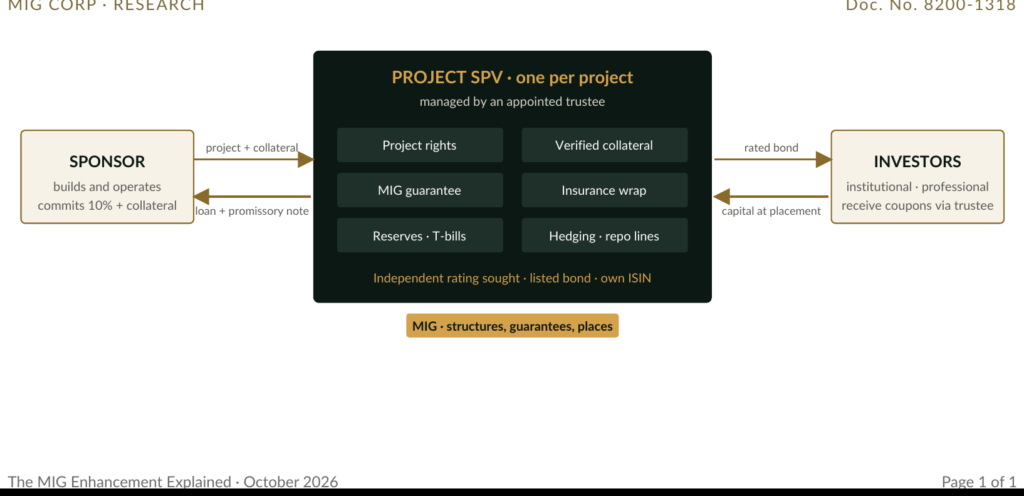
The sponsor receives the funds through a loan agreement and promissory note with the vehicle, disbursed to the project’s finance schedule. The sponsor builds and operates; the vehicle holds the rights and services the bond. If the project performs, everyone is paid in the order the documents set out. If it does not, bondholders look to the collateral and the enhancement inside the vehicle, not to the sponsor’s other businesses, and the sponsor’s other businesses are not exposed beyond what it committed.
3 · The four building blocks
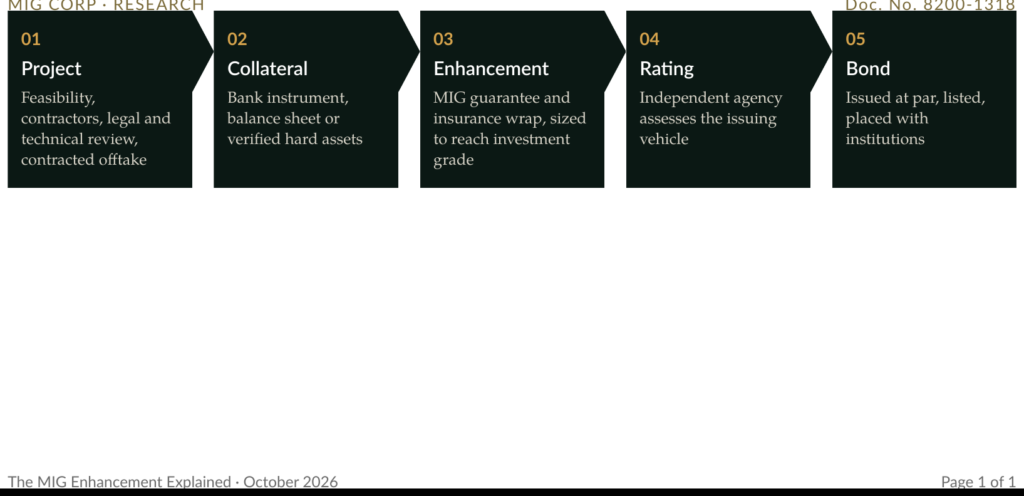
3.1 Project
It starts with a project that can be underwritten: feasibility and financial viability established; contractors and developers with records that can be checked; legal, accounting and engineering review; assets, contracts and market studies in the data room. Where the project sells its output, the strongest cases carry power purchase agreements or offtake contracts with rated counterparties. The contracted revenue is what the rating agency will test first.
3.2 Collateral
Collateral is the foundation of every issuance. The sponsor can provide it in several forms, and the coverage required relative to the bond’s face value depends on the quality of what is offered.
| Collateral offered | Coverage required, relative to bond face value |
|---|---|
| Standby letter of credit from an A+ rated bank | 100% |
| A+ rated corporate balance sheet | 70% |
| Non-A-rated corporate balance sheet | 50% |
| Verified hard assets | 50%, after independent verification of value and liquidity |
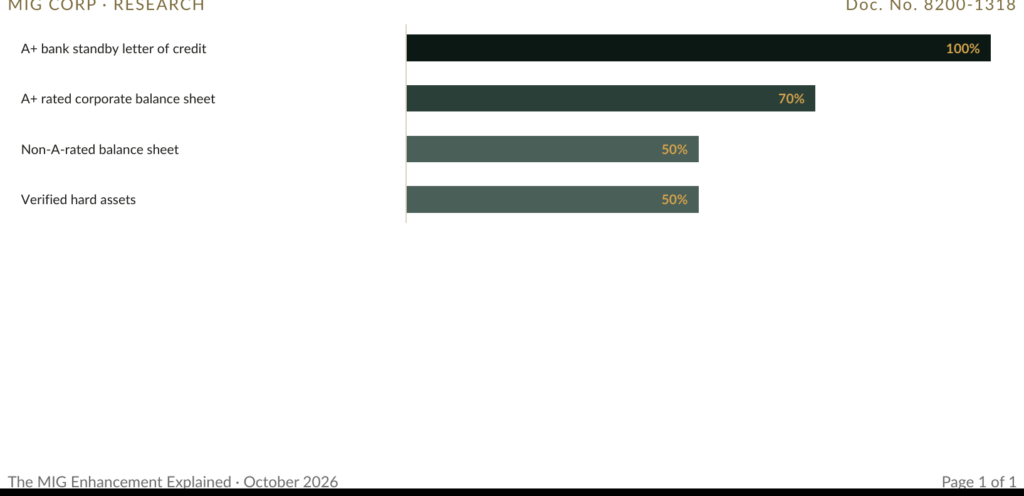
The percentages work in the structure’s favour rather than against the sponsor. An A+ bank instrument is accepted at full value because it is itself investment grade. Hard assets are accepted at half their verified value because they must be sold to be useful. A USD 200 million bond can therefore be collateralised by a USD 200 million bank instrument, by USD 400 million of verified assets, or by a combination.
Where the sponsor cannot provide collateral of sufficient quality, the process does not stall. MIG can provide the guarantee. That is the enhancement described next.
3.3 Credit enhancement
Enhancement lifts the structure from the credit quality of the collateral to the credit quality the bond market requires. There are two levels.
| Level | Applies to | What MIG does |
|---|---|---|
| Level 1 — Standard | Most projects | Where the project does not carry sufficient standalone credit quality, MIG provides a financial guarantee, standby letter of credit underwriting, to bring the structure to investment-grade standard, and an insurance wrap is layered on top to complete the enhancement. |
| Level 2 — Light touch | Select projects | Exceptionally strong fundamentals: verified cash-flow generation under contracted offtake with creditworthy counterparties. The collateral may already carry sufficient credit quality; only a minor insurance wrap is required and no MIG guarantee is needed. |
Where insurance is used, its premium is factored into the bond coupon. There is no separate out-of-pocket cost to the sponsor.
3.4 Rating
With project, collateral and enhancement in place, the issuing vehicle is presented to an independent rating agency: the credit package, site visits, management meetings. The target is an investment-grade rating. Whether it is obtained, and at what level, depends on the agency’s own assessment of the structure and the credit behind it. No rating is promised. What MIG commits to is a structure built to be rated, which is why the collateral and enhancement are sized before the agency is approached, not after.
3.5 Bond
The rated bond is issued by the vehicle at 100% of face value, listed on a recognised exchange, carries its own ISIN, and settles through the standard clearing systems. It is placed with institutional investors through a roadshow and book-building. Because reserves are added on top of the proceeds, the total cash available to the structure exceeds the bond offering itself.
3.6 How the bond is priced
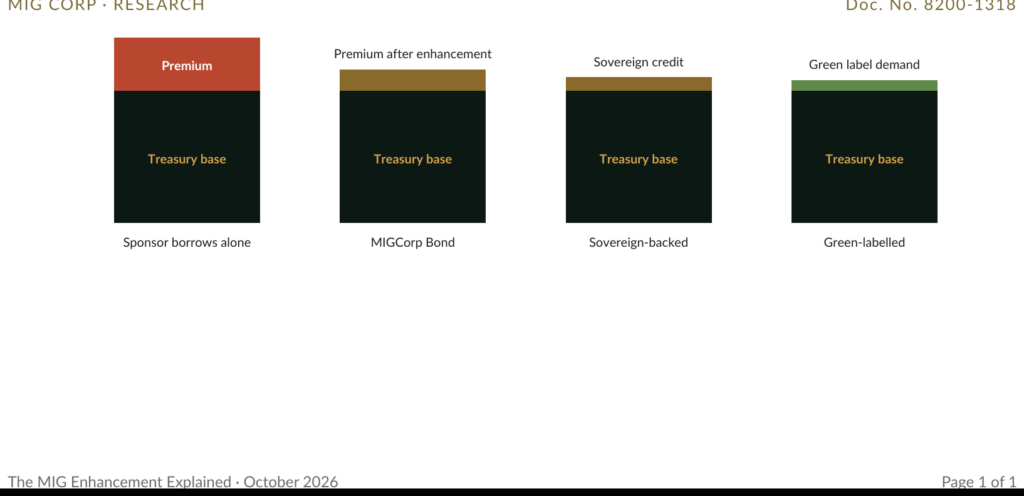
The coupon is built, not quoted. The base is the risk-free curve: the US Treasury yield for the bond’s tenor is the floor from which every MIGCorp Bond is priced. On top sits a premium for the environment the project lives in, country, sector, currency, legal system, the quality of the offtaker, and that premium is where the structure earns its keep. Every building block in this paper exists to make the premium smaller: a rated issuer instead of an unrated sponsor, verified collateral instead of a promise, a guarantee and a wrap instead of hope, a trustee instead of trust.
Two cases price differently. Where the project is sponsored or collateralised by a government, a sovereign offtake, a ministry guarantee, the credit behind the bond is the sovereign’s and the premium reflects that rather than the sponsor’s. And where the project qualifies for a green label, the bond plays in a different market: institutional demand for labelled paper is deep and the environmental benefit is itself priced, so green issues typically clear tighter than their conventional equivalents.
That is why MIG does not publish a single rate. The range reflects the base curve on the day, the premium the structure has been able to remove, and the market the paper is sold into. What stays constant is the method, and the result is a cost of capital that is, for an emerging-market project, extremely competitive.
4 · What sits inside the structure
The building blocks make the bond issuable. Four further elements keep it safe through its life.
| Element | What it does |
|---|---|
| Reserves | Standard reserves plus additional reserves are placed in cash and short-dated government securities, so that the structure is fully secured at all times and coupon payments do not depend on project cash flow in any single period. |
| Hedging | Interest-rate exposure is actively hedged, so the project’s cost of debt does not move with the market after closing. |
| Repo lines | MIG operates within bank repurchase lines, giving the structure a source of liquidity against its reserve assets throughout the bond’s life. |
| The trustee | The vehicle is managed by an appointed trustee who controls every payment: insurance premiums, project disbursements, coupons. The sponsor does not touch bondholders’ money; neither does MIG. All payment mechanics are written into the prospectus. |
| Banking and timing | The vehicle holds a dedicated account at a prime international bank under the trustee’s oversight. Collateral is deposited into the trust account at closing, once the trustee holds firm commitments from bond buyers; guarantees and insurance activate at the same moment. Nothing is pledged before the money is committed, and nothing is disbursed before the protection is in place. |
5 · Shared commitment: what MIG asks of the sponsor
MIG commits its guarantee, its network and its balance sheet to every transaction, and it asks the sponsor to commit too.
Every transaction requires the sponsor to commit the equivalent of 10% of the project financing, in cash or in kind: land, permits, completed works, equipment or other verified assets contributed to the project. This is the sponsor’s skin in the game alongside MIG’s own underwriting. MIG does not finance projects whose sponsors carry no risk themselves.
How the structuring cost is handled depends on where the risk sits.
| Engagement path | Where the risk sits |
|---|---|
| Path A — the sponsor provides collateral | The sponsor posts a fully cash-backed standby letter of credit or bank guarantee equal to the financing required, with a maturity matching the full term of the debt. MIG arranges the financing with no upfront cash from the sponsor. The risk sits with the sponsor’s collateral, which MIG draws on in the event of default or failure to proceed. |
| Path B — MIG underwrites | MIG bears the underwriting risk and structures the bond on the sponsor’s behalf. The structuring cost is paid upfront and in full. It is not a fee for advice: it funds the specialist third-party team, legal, technical, financial, rating, that MIG deploys from day one, and it is the sponsor’s commitment to a process with defined timelines. |
The structuring cost is refundable, with clear conditions. If MIG fails to issue the bond within the agreed timeline, MIG refunds it in full, under a corporate undertaking signed at engagement. In force-majeure cases, geopolitical disruption, regulatory change, loss of a project licence, both parties pause, evaluate jointly, and decide whether to resume or wind down; on a wind-down MIG refunds everything except third-party costs actually incurred, evidenced by invoices. What is not refundable is work already done and paid for on the sponsor’s behalf.
6 · Twenty weeks from engagement to disbursement
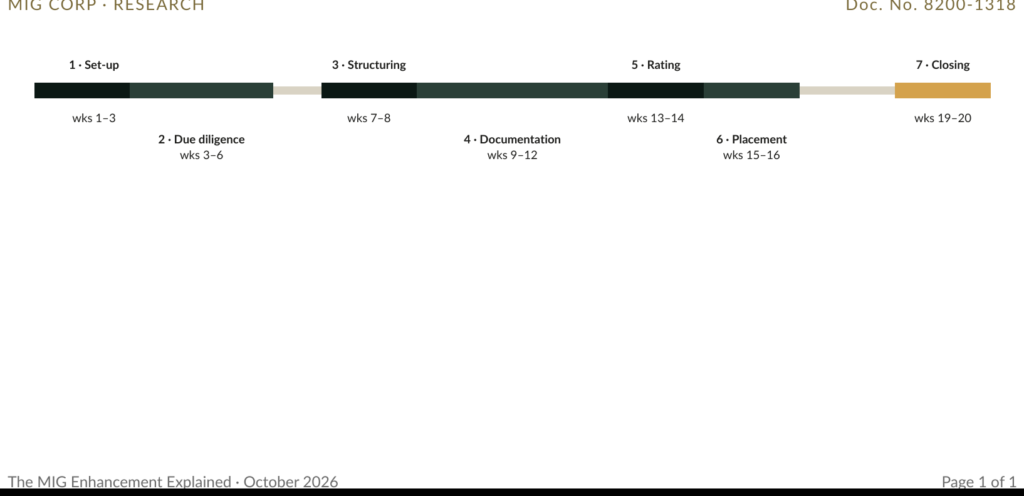
| Step | Weeks | What happens | What the sponsor does |
|---|---|---|---|
| 1 · Set-up | 1–3 | Engagement agreements signed; project team formed; data room established | Signs agreements; pays the structuring cost |
| 2 · Due diligence | 3–6 | Financial, technical and legal review of the project | Provides corporate documents, financials, technical specifications, permits |
| 3 · Structuring | 7–8 | Security package, covenants, payment mechanics and interest rate finalised | Reviews and approves the structure |
| 4 · Documentation | 9–12 | Offering memorandum, trust deed, subscription agreements, legal opinions | Available for queries on key documents |
| 5 · Rating | 13–14 | Agency presentation, site visits, rating assigned | Attends agency meetings where needed |
| 6 · Marketing and placement | 15–16 | Investor roadshow, book-building, price discovery, allocation | Joins investor presentations where needed |
| 7 · Closing and disbursement | 19–20 | Settlement; funds disbursed to the project’s finance schedule through the vehicle | — |
The timetable holds when all parties commit dedicated resources from the start. In MIG’s experience, delays come from incomplete documentation or slow sponsor response, not from the structure itself.
7 · Which projects fit
Size. From USD 50 million of bond face value.
Tenor. The ideal range is five to ten years, with seven years the most common and a two-year grace period standard. Longer tenors of fifteen years and more, typical for transmission and generation assets, are structured under a different model and discussed case by case.
Revenue. The strongest candidates have contracted revenue from creditworthy counterparties: availability payments, take-or-pay offtake, PPAs with rated buyers, long-term leases. Projects with merchant revenue can be structured, but need more collateral and enhancement, and the rating reflects it.
Sectors. MIG’s four verticals: agro-industry; energy, including floating LNG-to-power and the power behind AI data centres; infrastructure, real estate and mining, including transmission lines and real-estate acquisitions; and sports and entertainment infrastructure such as stadium and training facilities. The common thread is a long-life asset with contracted cash flow.
Formats. Where a project meets environmental criteria, a green-bond label can be applied, which typically attracts strong institutional demand. Sharia-compliant structures (Sukuk) are available.
Geography. Emerging markets are the point. MIG operates from Dubai across seven regions, and the structure exists because good projects in those markets deserve better capital than their sponsors’ local borrowing cost allows.
8 · What each party gets
| Party | Outcome |
|---|---|
| The sponsor | Keeps its project and its upside; reaches institutional capital at a cost set by the structure rather than by its own balance sheet; pays no separate insurance cost; and deals with one counterparty, MIG, for structuring, vehicle, trustee, insurance, rating, placement and disbursement. |
| Investors | Receive a listed, rated instrument from a single-purpose issuer, with verified collateral, a guarantee and an insurance wrap behind it, reserves in cash and government securities, hedged rates, and a trustee controlling every payment. |
| MIG | Earns its return by taking real risk, the guarantee, the underwriting, the balance-sheet commitment, on projects it has underwritten itself. That alignment is the structure’s credibility: MIG is not an adviser recommending a bond. It is a guarantor standing behind one. |
9 · The lender’s checklist, applied
Readers of When the power is late, who pays? will recognise the ten questions in its lender’s checklist. Three of them are answered by this structure directly. Who signs: a single-purpose issuer with verified collateral and MIG’s guarantee, not an unrated sponsor. Matched term: the bond’s tenor is set to the contracted revenue behind it. Disbursement against progress: the trustee releases funds to the project’s schedule, so interest does not run ahead of the asset. The others, force-majeure drafting, fuel pass-through, delay liquidated damages, are written into the project documents the vehicle holds.
MIG Corp publishes research on the structuring and financing of emerging-market infrastructure. Related papers: The MIG Enhancement Explained (8200-1318); When the power is late, who pays? (8200-1319); MIGCorp Bond one-pager (8200-1313); Financing AI Data-Centre Power (8200-1312); Floating LNG-to-Power for AI Data Centres (8200-1311). Further information on specific transactions is available under NDA from investments@mig-corp.com.
This paper is for information only and does not constitute an offer or solicitation. MIG International Ltd — RAK ICC Reg. No. A002/09/12/5254 — investments@mig-corp.com · mig-corp.com
The MIGCorp Bond™ is not a corporate bond of MIG International Ltd, is not a fund, and is not an offer of securities to the public. Each issuance is separately documented and separately rated, and is made available only to qualified institutional and professional counterparties. An investment-grade rating is sought for the issuing vehicle of each transaction; whether it is obtained, and at what level, depends on the structure, the credit profile and the agency’s own assessment. No rating is guaranteed. Worked examples are illustrative and do not describe any specific transaction or counterparty.
© 2026 MIG International Ltd. This paper may be quoted and shared with attribution and a link to mig-corp.com; it may not be sold or altered.