
Summary
Everyone building AI capacity has run into the same wall, and it is not chips. It is the five to ten years it takes to bring new power to a site, against the one or two it takes to build the hall that needs it. We put a number on that gap in When the power is late, who pays?: on our illustrative model, 100 megawatts of built, unpowered capacity costs around a billion dollars a year to carry. Late power is far more expensive than costly power.
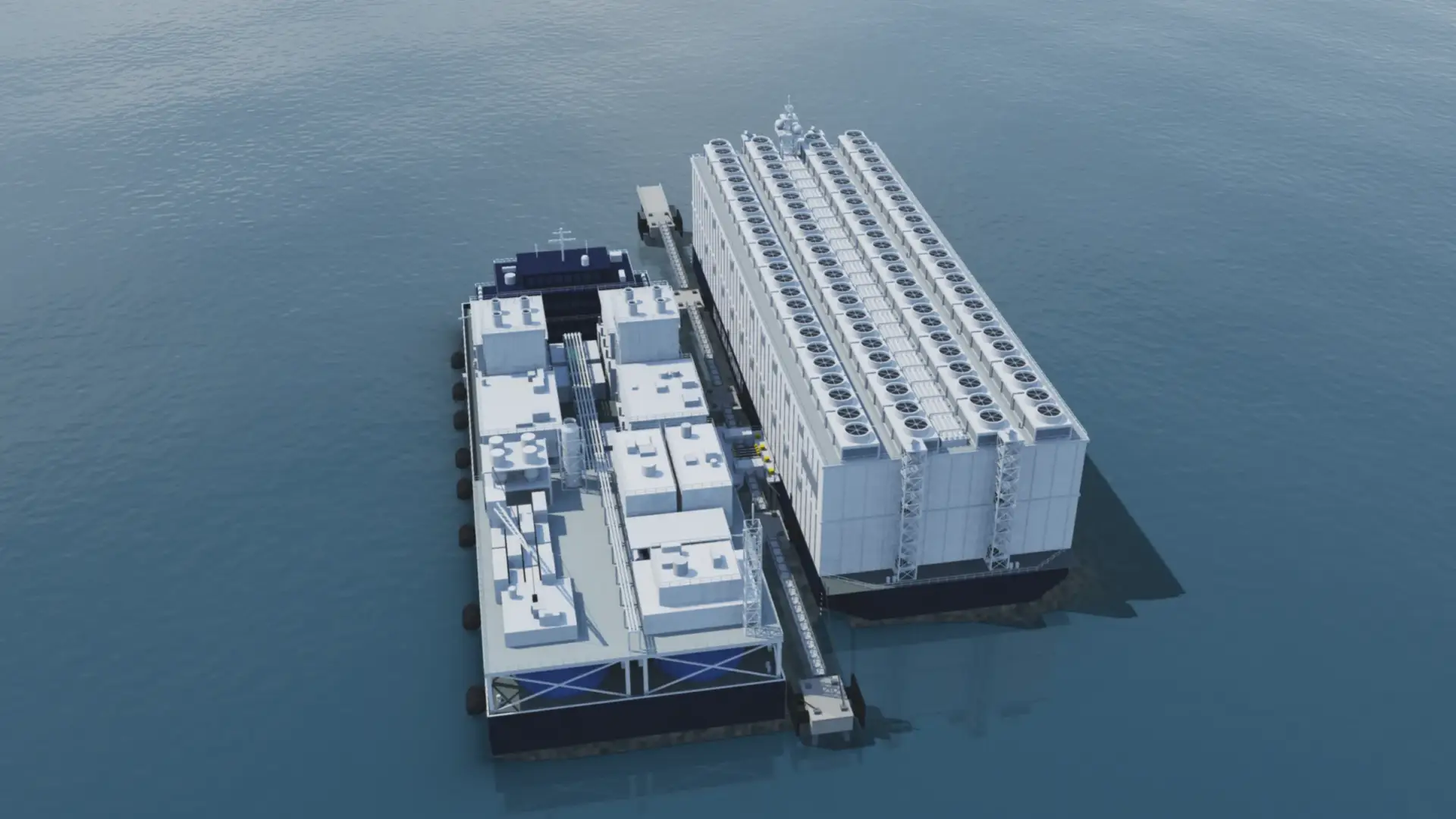
This paper is about the answer we are building with Blue Sea Power: the power plant and the data centre on the water, together, at the same berth. A floating LNG-to-power barge, built in a shipyard, moored where the demand is, and a compute barge alongside it, cooled by the sea and fed by a cable a few metres long. Neither waits for a grid queue, a substation or a land deal. Both leave a yard on a schedule a lender can underwrite.
It is a design paper and a financing paper at once, because in our experience the two cannot be separated. What follows is where the idea comes from, what the combined site looks like, what it does to the risks a lender prices, and how we would finance it.
1 · Where it comes from
Blue Sea Power’s floating storage, regasification and power plant was designed for a narrower problem than AI: islands and coastlines that burn diesel and heavy fuel oil because the grid never reached them. A non-propelled barge holds LNG or bio-LNG in cryogenic tanks, regasifies it on board, and generates electricity with gas engines, in configurations of roughly 50 to 200 megawatts. It is towed to a berth, moored, connected, and running within weeks of arrival. The components, floating regasification, gas-engine barges, ship-to-ship transfer, have been in commercial service for ten to twenty years. The platform puts them on one classed hull.
The lesson from the first deployments was about time rather than cost. A floating plant at a berth is delivering power while the equivalent land plant is still in the permitting queue. For an island utility that is a convenience. For an AI operator whose carry on an unpowered site runs to tens of millions a month, it is the whole proposition.
2 · The combined site
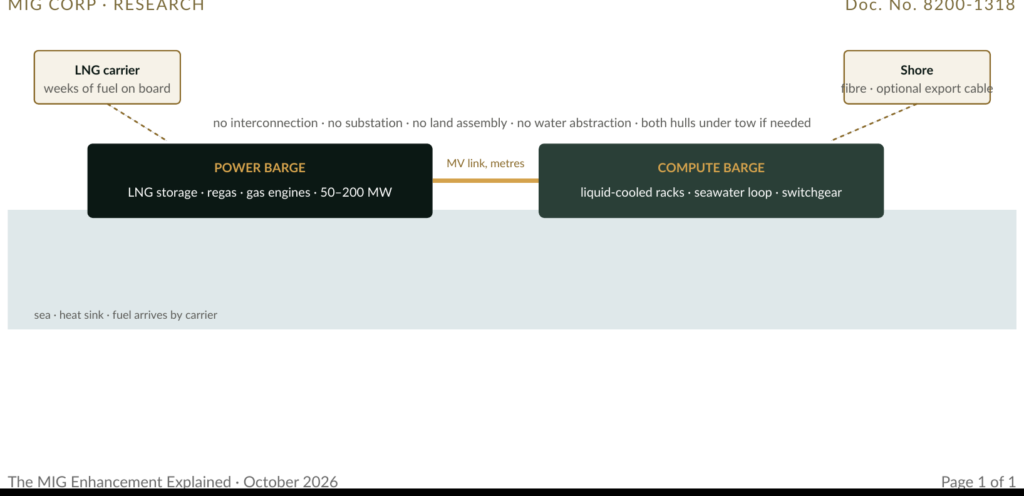
Put a second barge beside the first. The compute barge is a hull purpose-built to house high-density racks, liquid-cooled, with seawater as the heat sink through a closed loop, and with its own switchgear, fire suppression and redundant distribution. The power barge supplies it over a short medium-voltage link. Fibre comes ashore with the mooring. Surplus power, if the host grid will take it, goes out through a shore cable; if not, the site runs behind the meter entirely.
What this removes from the critical path of a land campus is almost everything. There is no interconnection application, because there is no interconnection. There is no substation, no transmission line, no twenty hectares of land to assemble, no water abstraction permit. The marine permits, the port works and the classification survey are real and take time, but they are a different kind of time: a shipyard’s and a port authority’s, which are schedules with owners, rather than a transmission queue’s, which is a schedule with none.
Three design points matter for a lender, and we have organised the engineering around them.
Fuel. The site carries weeks of LNG on board and is replenished by carrier, so its fuel logistics are those of any coastal LNG terminal, a supply contract and a shipping schedule, rather than a pipeline that has to be permitted. Fuel price risk is passed through to the compute tariff, as it would be under any power contract we finance.
Cooling. The sea is a larger and more reliable heat sink than any inland site can buy, and liquid cooling against it takes a large part of the overhead out of the power budget. A floating site in a hot climate is cooler to run than a land site in the same place.
Movability. Both barges are under tow if they need to be. If the offtaker fails, the site goes to the next berth and the next contract. If the host becomes unsafe, the site leaves. Lenders to land-based data centres have no such remedy, and in the Gulf in particular, where fixed sites now carry physical-security risk, the value of a site that can move has become easier to explain.
3 · What it does to the risks a lender prices
Our lender’s checklist in When the power is late, who pays? has ten questions. The floating site answers several of them structurally.
Who signs is unchanged: we still want an investment-grade parent, or payment security, behind the compute offtake. But take-or-pay from the day power is available becomes a credible term, because the day power is available is a date a shipyard has committed to, not a date a utility has estimated. Matched term is easier, because the asset’s life and the contract’s length are both set by the same parties. Delayed-draw debt fits naturally, because the yard’s milestones are the drawing schedule. Customer-funded long-lead equipment is replaced by yard refund guarantees and performance bonds, the instruments ship finance has used for a century. Fuel pass-through is written into the compute tariff. Bring your own power is the design.
The risks that remain are marine, and they are the ones a lender can price. Classification and hull and machinery insurance. Port and mooring works. War-risk cover where the berth is in a region that needs it. Host-country marine permitting, which varies and must be understood case by case. None of these is new to the market; what is new is seeing them on a data-centre term sheet.
4 · Financing it
The financing is the structure in Financing AI Data-Centre Power, applied to two hulls.
A dedicated vehicle holds the power barge, the compute barge, the charter or lease arrangements, the fuel supply agreement, the compute contracts and any surplus-power PPA. The vehicle issues a bond sized to the committed compute revenue plus any firm power sales, with a tenor inside the compute contracts. Construction is covered the way a shipyard contract is covered: refund guarantees on advances, delay and performance damages from the yard, drawings certified against milestones and released by the trustee. The trustee controls the collection account; compute tenants pay the vehicle. Reserves, hedged rates and repo lines sit inside. MIG’s guarantee and an insurance wrap lift the vehicle to investment-grade standard, a rating is sought, and the sponsor commits the equivalent of 10% in cash or in kind.
Two features of the floating site change the financing for the better. Because the asset can be moved, the residual value a lender assigns to it is higher than for a land site tied to one customer, and the remedy on default is a tow rather than a workout. And because the power and the compute are owned together, there is no gap between the plant’s PPA and the hall’s lease for a delay to fall into. The question this whole series keeps asking, who pays when the power is late, does not arise in the same way, because the power and the load arrive on the same schedule, from the same yard.
5 · Where we are
Blue Sea Power’s power barges are in development for island and coastal deployments in Greece and under evaluation elsewhere in South-East Europe, the Mediterranean and the Middle East and North Africa. Together we are working on the compute barge and the combined site configuration. We will publish the engineering and the first site as they mature; this paper exists to set out the architecture and the financing logic ahead of that.
We see the combined site as the first step, not the last. The same mooring and the same compute platform can be fed by whatever floating generation the market and the regulators allow, and we expect that over time to mean cleaner fuel than LNG. The design is built so that the power barge can change and the compute barge need not.
Nothing here describes a specific transaction or site. Figures for the carry of unpowered capacity are from our illustrative model and are explained in When the power is late, who pays?.
MIG Corp publishes research on the structuring and financing of emerging-market infrastructure. Related papers: The MIG Enhancement Explained (8200-1318); When the power is late, who pays? (8200-1319); MIGCorp Bond one-pager (8200-1313); Financing AI Data-Centre Power (8200-1312); Floating LNG-to-Power for AI Data Centres (8200-1311). Further information on specific transactions is available under NDA from investments@mig-corp.com.
This paper is for information only and does not constitute an offer or solicitation. MIG International Ltd — RAK ICC Reg. No. A002/09/12/5254 — investments@mig-corp.com · mig-corp.com · blueseapower.eu
The MIGCorp Bond™ is not a corporate bond of MIG International Ltd, is not a fund, and is not an offer of securities to the public. Each issuance is separately documented and separately rated, and is made available only to qualified institutional and professional counterparties. An investment-grade rating is sought for the issuing vehicle of each transaction; whether it is obtained, and at what level, depends on the structure, the credit profile and the agency’s own assessment. No rating is guaranteed. Worked examples are illustrative and do not describe any specific transaction or counterparty.
© 2026 MIG International Ltd. This paper may be quoted and shared with attribution and a link to mig-corp.com; it may not be sold or altered.