
Summary
Most of the infrastructure an emerging economy needs is bought by the state. Transmission by the national utility, generation by a ministry, water and roads and ports by a government agency. On a large share of the projects worth doing, then, the counterparty whose payments service the debt is the sovereign, in one form or another.
That is a strange position for a lender to be in. The sovereign is often the best credit in the country and the payer the market trusts most. It is also the borrower whose balance sheet is watched most closely, whose debt ratios set its own cost of money, and whose finance ministry has every reason to say no to one more guarantee.
We get out of this by keeping two things apart that the market tends to run together: the state’s obligation to pay for what it buys, and the state’s own borrowing. A project financed against a sovereign purchase contract, set up properly in its own vehicle with the right support and the right escrow, carries the sovereign’s credit without adding to the sovereign’s debt. The state gets its infrastructure. The lender gets a sovereign-linked payment stream. The economy keeps its borrowing capacity for the things only the state can do. This paper is about how that is done. The figures in it are illustrations, not transactions.
1 · A purchase is not a loan
A sovereign offtake is a contract under which a state entity commits to pay for a service over a term at a price: available transmission capacity, available generation, treated water, a road kept open. The state buys the service and pays as it is delivered. The project builds the asset, operates it, and borrows against the contracted payments.
The difference from a loan matters to three people. To the lender, because the state’s obligation to pay an invoice is a different and often stronger obligation than its promise to repay a bond; states that restructure their bonds generally keep paying for the electricity. To the state, because the project’s debt is the project’s, provided the contract is drafted so that the state’s exposure is to the service and not to the financing. And to the rating agency, because the question becomes how the state’s obligation is supported, by guarantee, escrow, budget appropriation or regulatory pass-through, and how well that support is documented.
2 · What stands behind the offtaker
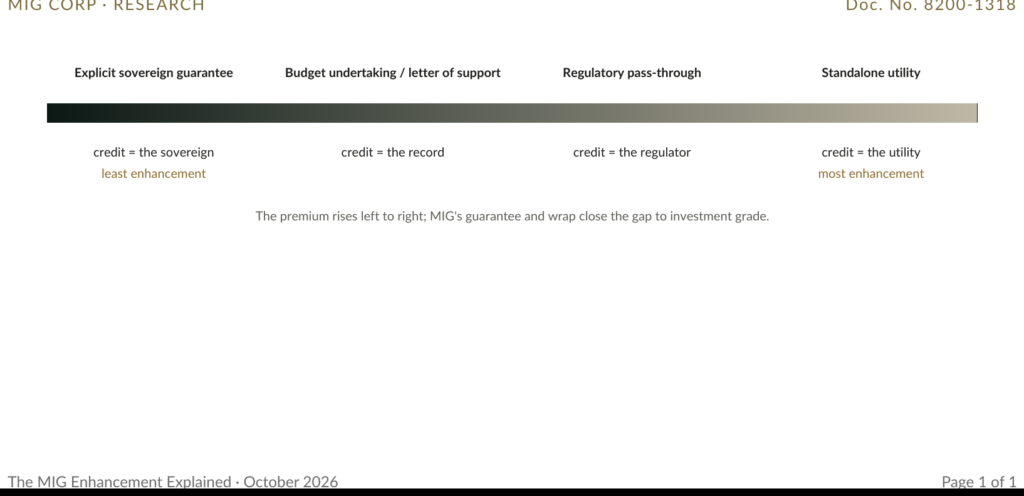
The offtaker is rarely the state itself. It is a utility, an agency, a ministry: a legal person with its own balance sheet. The first job is to work out what stands behind it, and the answers sit on a spectrum.
At one end, an explicit sovereign guarantee: the ministry of finance guarantees the offtaker’s payments under the contract. The credit is the sovereign’s. This is the strongest support and the hardest to get, because it shows up in the state’s contingent liabilities and finance ministries ration it.
Next, a budget undertaking or letter of support: the state undertakes to appropriate the payments each year, or writes a letter that stops short of a guarantee. Weaker on paper, often honoured for decades in practice. What the lender is analysing is the record, not the letter.
Then regulatory pass-through: the offtaker is a regulated utility whose consumer tariff is set to recover its purchase costs, including this project’s. The support is structural rather than contractual. The lender’s analysis is of the regulator, its independence and its history.
At the far end, a standalone utility with no sovereign support, paying from its own revenue. Financeable where the utility is well run and the payment security is strong, priced as the utility’s credit rather than the state’s.
We work across the whole spectrum. What moves is the premium and how much enhancement the structure needs to reach investment grade.
3 · Extracting the debt from the contract
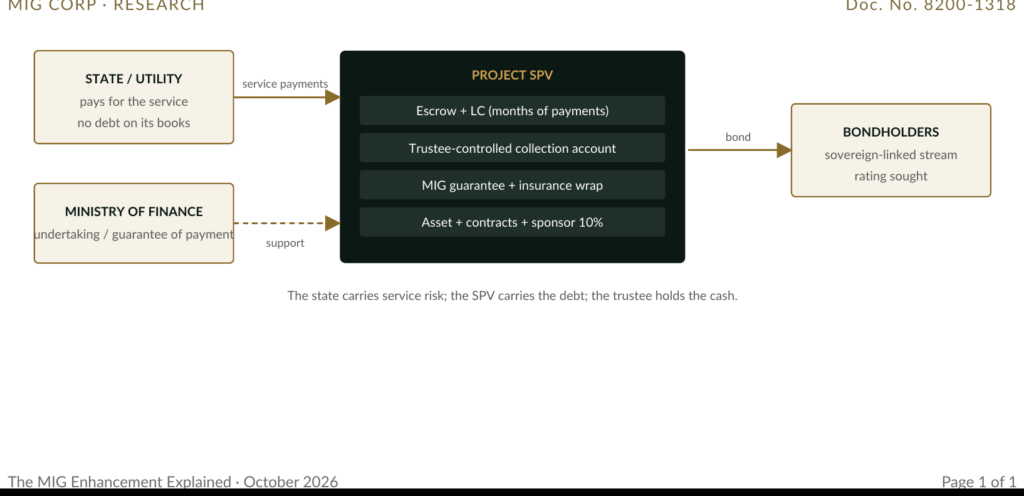
The offtake contract is the asset. The structure exists to isolate it, protect it and borrow against it without the debt ever attaching to the state.
The project, meaning the asset, the offtake contract, the construction and operating contracts and the receivables, sits in a vehicle set up for that project and nothing else. The vehicle borrows. The state does not. The state’s obligation is to pay the vehicle for the service.
The offtaker pays into a collection account the trustee controls, at a prime international bank, out of the offtaker’s reach once paid and out of the sponsor’s reach entirely. The money moves through the waterfall: operating costs, debt service, reserves, then the sponsor.
The offtaker pre-funds an escrow, typically several months of payments, or provides a letter of credit from a rated bank. Late payment is cured from the escrow; the escrow is refilled before any distribution. With a sovereign offtaker this is the single most valuable protection we can obtain, because it turns a promise into cash the trustee is already holding.
Where the ministry of finance guarantees the offtaker’s obligations, the guarantee is assigned to the vehicle and through it to the bondholders. Where it is not available, MIG’s own guarantee and the insurance wrap provide the enhancement the structure needs.
If the state terminates the contract, for convenience, for a change in law, or for its own default, it pays a termination amount that repays the debt. If the project terminates for its own default, the lender has step-in rights to keep the contract alive. The termination clause is where you find out whether the state’s commitment is real.
Payments in local currency against dollar debt need indexation or a hedge. The contract should also deal with convertibility and transfer, ideally with the central bank’s acknowledgement, so that the trustee can move dollars out when they are due.
4 · Keeping it off the economy’s books
A properly structured sovereign offtake does not add to public debt, and the reason is substantive rather than cosmetic. The state has not borrowed. It has contracted to buy a service. Its exposure is a long-term purchase commitment, disclosed as one, not a liability on the balance sheet. The debt sits in the vehicle, serviced by the project’s revenue, with recourse to the project’s assets and contracts.
Three conditions keep it there. The state must not guarantee the debt itself; it may guarantee its own payment obligations under the contract, which is a different thing. The state must carry service risk and not financing risk: it pays for availability or output, and if the asset is not available it does not pay. And the vehicle has to be a real project company with real risk transfer, a sponsor that builds, operates and puts capital in, not a shell that lends the money straight back to the state.
For a finance ministry managing a debt ceiling, an IMF programme or a rating, this is often the difference between a project that happens and one that waits.
5 · What a sovereign-linked stream costs
The coupon is built the way we build every coupon: the Treasury curve for the tenor, plus a premium for the environment. For a sovereign-linked offtake the premium depends on the sovereign’s own credit and on how tightly the structure ties the stream to it. An explicit guarantee, an escrow and a trustee-controlled account bring the premium close to the sovereign’s own spread. A standalone utility with weak payment security sits further out and needs more enhancement.
Two things work in the structure’s favour. A sovereign’s obligation to pay for an essential service has historically been honoured more reliably than its bonds, and investors price that. And where the project qualifies, the green label opens a deeper pool of institutional demand for sovereign-linked paper. For a well-structured sovereign offtake in an emerging market the result is a cost of capital the state could not match by borrowing directly, without the borrowing.
6 · A worked illustration
A state utility contracts to buy available capacity from a new plant for twenty years under a capacity-based PPA with fuel passed through. The ministry of finance issues a payment undertaking rather than a guarantee. The utility pre-funds an escrow of six months’ capacity payments and provides a standby letter of credit for six more. Payments are dollar-indexed and the central bank acknowledges the transfer mechanism. The sponsor commits the equivalent of 10% of the financing in land, permits and equity, and operates the plant under a performance-based agreement.
The vehicle issues a seventeen-year bond against the twenty-year PPA. The trustee controls the collection account. MIG provides a guarantee sized to the gap between the undertaking-supported stream and investment-grade standard; an insurance wrap completes the enhancement; a rating is sought. The state’s exposure is a purchase commitment for available capacity. Its public debt is unchanged.
| Element | Who provides it | What it does |
|---|---|---|
| Capacity-based PPA, 20 years | Utility and sponsor | Contracted, dispatch-independent revenue |
| Payment undertaking | Ministry of finance | Ties the stream to the sovereign without a debt guarantee |
| Escrow, 6 months, plus LC, 6 months | Utility | Turns a promise into cash the trustee holds |
| Dollar indexation; transfer acknowledgement | Contract; central bank | Closes currency and transfer risk |
| Dedicated vehicle, trustee account, waterfall | MIG | Isolates the contract; controls the cash |
| MIG guarantee and insurance wrap | MIG | Lifts the vehicle to investment-grade standard |
| Sponsor 10%; performance-based operation | Sponsor | Real risk transfer; keeps the debt off the state’s books |
| 17-year bond, rating sought | Vehicle | Institutional capital at a sovereign-linked price |
Illustrative only. No transaction is described.
Before we structure against a sovereign offtake we want to know what stands behind the offtaker; whether the state is guaranteeing its payment obligations or the debt, because it should be the former; whether there is an escrow or letter of credit and how many months it covers; whether the offtaker pays into a trustee-controlled account; what the termination regime is and whether it repays the debt; whether currency, convertibility and transfer are addressed with the central bank’s acknowledgement; whether the state carries service risk rather than financing risk; whether there is a sponsor that builds, operates and commits capital; and whether the tenor sits inside the contract with a tail. Where those answers are good, the premium ends up close to the sovereign’s own, and the sovereign has borrowed nothing.
MIG Corp publishes research on the structuring and financing of emerging-market infrastructure. Related papers: The MIG Enhancement Explained (8200-1318); When the power is late, who pays? (8200-1319); MIGCorp Bond one-pager (8200-1313); Financing AI Data-Centre Power (8200-1312); Floating LNG-to-Power for AI Data Centres (8200-1311). Further information on specific transactions is available under NDA from investments@mig-corp.com.
This paper is for information only and does not constitute an offer or solicitation. MIG International Ltd — RAK ICC Reg. No. A002/09/12/5254 — investments@mig-corp.com · mig-corp.com
The MIGCorp Bond™ is not a corporate bond of MIG International Ltd, is not a fund, and is not an offer of securities to the public. Each issuance is separately documented and separately rated, and is made available only to qualified institutional and professional counterparties. An investment-grade rating is sought for the issuing vehicle of each transaction; whether it is obtained, and at what level, depends on the structure, the credit profile and the agency’s own assessment. No rating is guaranteed. Worked examples are illustrative and do not describe any specific transaction or counterparty.
© 2026 MIG International Ltd. This paper may be quoted and shared with attribution and a link to mig-corp.com; it may not be sold or altered.