
Summary
Non-recourse lending is lending to a plant instead of to the people who own it. The lender’s security is the project and nothing else: the asset, the contracts, the bank accounts. If it fails, the lender takes the project. The owner’s other businesses are out of reach.
In Europe and North America this is the ordinary way to finance a power station. In the markets where we work it is rarer than it ought to be, and the reason is not a shortage of good projects. It is that a non-recourse lender needs two things, an offtaker it can trust and a structure it can trust, and in emerging markets the second is usually missing. We supply the second so that the first becomes financeable.
This paper is about how we underwrite a generation project on that basis: what we need to see in the power purchase agreement, how the debt is sized and stressed, where our own enhancement sits, and what we ask before we commit. It applies to gas, LNG-to-power, hydro and renewables alike. The fuel changes; the method does not.
1 · What “non-recourse” commits you to
Because the loan is repaid only from the project’s cash, everything the lender relies on has to be inside the project perimeter. The PPA, the fuel supply, the construction contract, the operating agreement, the insurances, the permits and the accounts: if it is not in the perimeter, it does not count.
Two things follow, and they drive the rest of this paper.
The contract is the credit. With no balance sheet behind the loan, the quality of the PPA, who pays, for how long, under what conditions, with what protection when they are late, decides whether the plant can be financed at all and what it will cost.
And the structure is the protection. The lender cannot rely on the sponsor, so it relies on procedure instead: accounts the sponsor cannot reach, reserves that are funded before anyone takes a distribution, covenants that trap cash when coverage slips.
2 · Reading the PPA
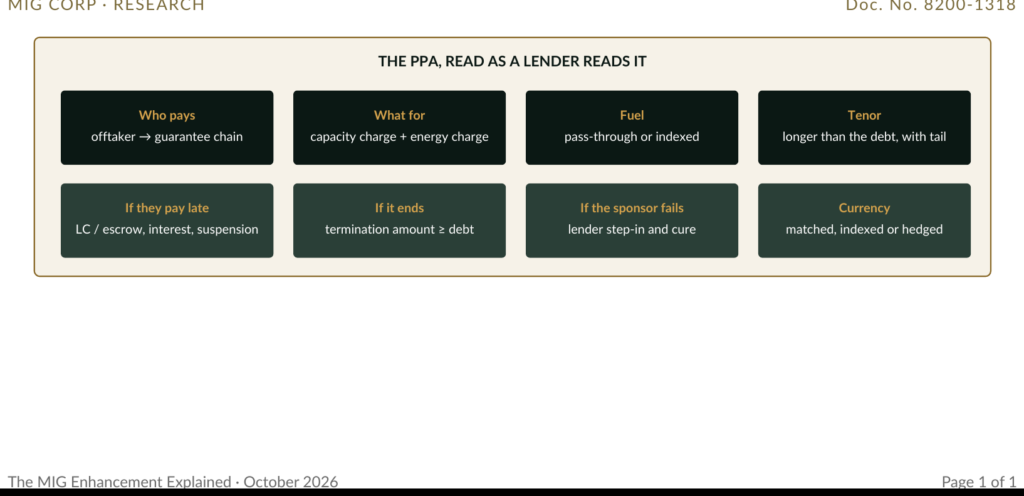
The power purchase agreement is the document we read first and longest, and the questions are the same whether the plant burns gas or catches wind.
Who is the offtaker, and what is behind it? A national utility, a ministry, a rated industrial buyer, a data-centre operator. The offtaker’s credit is the ceiling on the project’s credit. We look through it: a state utility with a ministry of finance guarantee is a sovereign risk; the same utility without one is its own risk.
What exactly does it pay for? The PPAs we like best pay a capacity charge for the plant being available, sized to cover debt service, fixed costs and a return on equity, plus an energy charge for what is actually dispatched. Under that arrangement the lender is paid whether or not the plant runs, so long as it can run. An energy-only PPA, paid per megawatt-hour delivered, puts dispatch risk on the lender, and we finance it with less debt at a higher price.
Who carries the fuel? For gas, LNG and anything thermal, fuel is the biggest cost and the most volatile. We need it passed through: the offtaker pays fuel at cost, or the energy charge is indexed to the fuel price. A fixed energy tariff against a floating fuel bill is a position we do not finance, and we have turned down projects on this point alone.
How long? The PPA must outlast the debt, with margin. A fifteen-year PPA supports twelve or thirteen years of debt. It does not support twenty, however the sponsor’s model is built.
What happens when they pay late? Late-payment interest, a payment security of several months’ invoices in a letter of credit or an escrow, and a right to suspend supply after a cure period. A PPA with no payment security is a PPA we will have to enhance.
What happens if it ends? If the offtaker terminates for convenience or for its own default, it owes a termination amount that at least repays the debt. If the project terminates for its own default, the lender needs step-in rights: the ability to take over, cure, and keep the PPA alive.
Which currency? A local-currency tariff against dollar debt is a mismatch. Either the tariff is dollar-indexed, or the risk is hedged, or the debt is in local currency. We do not carry it open.
3 · Sizing the debt
With the PPA understood, the cash flows get built: capacity revenue, energy revenue, fuel pass-through, operating costs, maintenance reserves, insurance, tax. What is left is cash flow available for debt service, year by year over the PPA.
Debt is then sized backwards against a minimum coverage ratio. For a capacity-based PPA with a creditworthy offtaker the ratio can be modest, because the revenue that services the debt does not depend on dispatch. For an energy-only PPA or a weaker offtaker it rises and the debt falls. Tenor sits inside the PPA with a tail, the years of contract left after the debt is gone, so that a slipped schedule has somewhere to go.
| Input | Source | How we treat it |
|---|---|---|
| Capacity revenue | Capacity charge × contracted MW × availability | Base at contracted availability; stressed lower |
| Energy revenue | Energy charge × dispatched MWh | Base at expected dispatch; stressed to zero if capacity-based |
| Fuel | Pass-through or indexed | Neutral if passed through; stressed if not |
| Operating costs | O&M contract, insurance, admin | Contracted where possible; inflated |
| Major maintenance | Overhaul schedule | Reserve funded ahead of each overhaul |
| Cash available for debt service | Revenue less costs less reserves | Basis for sizing |
| Debt service | Principal and interest at the structure’s coupon | Sized to the minimum ratio |
Then we break it. Availability falls. Dispatch goes to zero. Fuel spikes with no pass-through. Construction is a year late. The offtaker pays ninety days late. Rates are higher than the hedge. A project that comes through all of that with coverage above one is financeable. One that does not needs less debt or more structure, and usually we can tell which from the shape of the failure.
4 · Accounts, reserves, waterfall
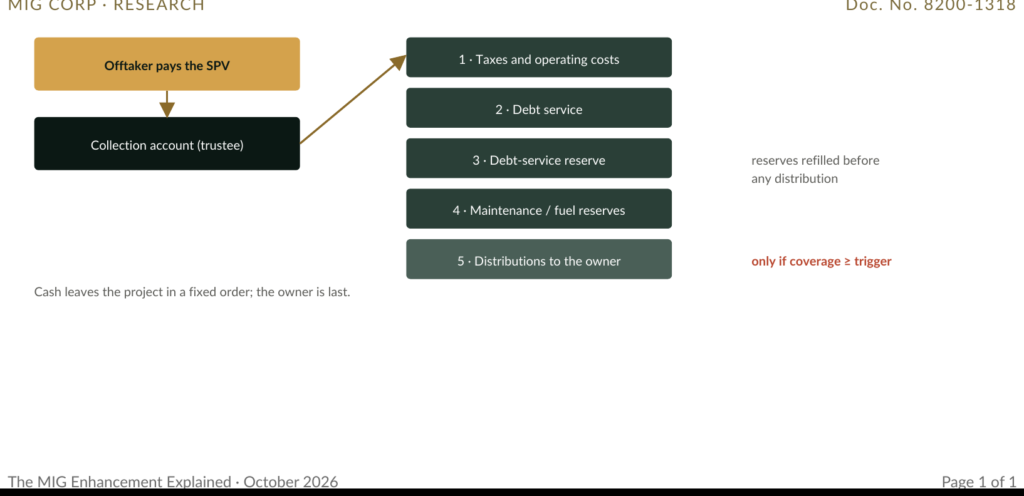
Non-recourse lenders control cash by controlling where it goes. Every receipt lands in a collection account the trustee or agent controls, and leaves it only in a fixed order: taxes and operating costs, then debt service, then the reserves, and only then, if coverage is above the trigger, the owner.
The reserves are the shock absorbers. A debt-service reserve holding six to twelve months of payments. A maintenance reserve that builds ahead of each overhaul. A fuel reserve where fuel is not passed through. They are funded before distributions, and if they are drawn, distributions stop until they are whole again.
Around all this sits the legal package: step-in and cure rights, direct agreements with the offtaker and the contractors, assignment of insurances, security over shares and assets. It exists for one reason, so that if the sponsor fails the lender can keep the plant running and the PPA in force.
5 · Where our enhancement sits
Everything so far is standard practice. What we add is the layer that makes it work in places where the offtaker’s credit, the legal system or the sponsor’s record would otherwise keep the project out of the institutional market.
The project goes into a dedicated vehicle. Collateral is verified and sized by quality. Where the project’s own credit is not enough, MIG provides a financial guarantee and an insurance wrap completes the enhancement; where the PPA is with a rated counterparty and the cash flows are strong, a light wrap may be all that is needed. Reserves in cash and government securities, hedged rates and repo lines sit inside. The trustee runs the collection account, so the offtaker pays the vehicle. A rating is sought for the vehicle, and the debt goes out as a bond rather than a bank loan, which opens the institutional market and matches the PPA’s tenor in a way bank balance sheets rarely can.
The sponsor commits the equivalent of 10% of the financing in cash or in kind, and the structuring cost where we underwrite. Construction and operation stay with the sponsor; money is released against progress through the trustee, so interest does not run ahead of the asset.
What changes is the price and the availability of capital, not the cash flows. A PPA that would support twelve-year bank debt at a wide margin, if a bank could be found, supports a rated bond priced from the Treasury curve plus a premium the structure has shrunk. The discipline is unchanged.
6 · Notes by technology
Gas and LNG-to-power, fixed or floating. Fuel pass-through is non-negotiable, and fuel supply has to be contracted for the PPA term with a supplier and a delivery route the lender can underwrite. For a floating plant the mooring, the port, classification and marine insurance are part of the credit. So is the fact that it can be moved, which lenders are starting to price as a strength: the plant earns when the vessel is moored, not when the grid queue clears, and the period between drawing debt and earning revenue is shorter.
Hydro. Hydrology does the job fuel does elsewhere. We want a long record, a conservative P90 case, and a PPA whose capacity element does not depend on water.
Solar and wind. Resource risk is well understood and lower than hydro; the credit question is almost entirely the offtaker. Energy-only PPAs are the norm and the coverage ratio reflects it.
Behind-the-meter and data-centre power. One customer, whose own project risk is the lender’s risk. Our paper When the power is late, who pays? is about that case.
7 · What we ask before we commit
Who is the offtaker, and what stands behind it. Whether the PPA is capacity-based or energy-only. Whether fuel is passed through, and if not, who carries it. Whether the PPA outlasts the debt. What payment security exists. What the termination amount is and whether it repays the debt. Whether there is a currency mismatch and how it is closed. Whether the project survives the stresses with coverage above one. Whether cash is controlled from the collection account down. Whether the lender can step in. And where the enhancement sits and what it does to the price.
If the answers are good, the rest is documentation. If they are not, no amount of structure fixes a bad PPA, and we say so early.
MIG Corp publishes research on the structuring and financing of emerging-market infrastructure. Related papers: The MIG Enhancement Explained (8200-1318); When the power is late, who pays? (8200-1319); MIGCorp Bond one-pager (8200-1313); Financing AI Data-Centre Power (8200-1312); Floating LNG-to-Power for AI Data Centres (8200-1311). Further information on specific transactions is available under NDA from investments@mig-corp.com.
This paper is for information only and does not constitute an offer or solicitation. MIG International Ltd — RAK ICC Reg. No. A002/09/12/5254 — investments@mig-corp.com · mig-corp.com
The MIGCorp Bond™ is not a corporate bond of MIG International Ltd, is not a fund, and is not an offer of securities to the public. Each issuance is separately documented and separately rated, and is made available only to qualified institutional and professional counterparties. An investment-grade rating is sought for the issuing vehicle of each transaction; whether it is obtained, and at what level, depends on the structure, the credit profile and the agency’s own assessment. No rating is guaranteed. Worked examples are illustrative and do not describe any specific transaction or counterparty.
© 2026 MIG International Ltd. This paper may be quoted and shared with attribution and a link to mig-corp.com; it may not be sold or altered.