
Summary
Of all the power assets one can lend to without recourse, a transmission line is the easiest to underwrite and, in our experience, the one most often financed badly. Easiest, because the revenue is an availability payment: contracted, long, indexed, and indifferent to how much power flows. Badly, because the two things that do go wrong with a line, construction and counterparty, are exactly the two a lender cannot afford to misjudge when there is no sponsor balance sheet behind the loan.
This is the companion to Non-recourse lending for power generation and How to discount a transmission line. It covers what the other two do not: how construction risk is carried before the line has earned anything, how a concession becomes security, how the debt is sized against availability rather than dispatch, and what our enhancement adds. The experience behind it is Central American.
1 · Why a line is not a plant
Three differences shape everything.
There is no dispatch risk. A plant is paid, at least partly, for what it produces. A line under an availability concession is paid for being able to carry power. Demand, fuel, hydrology and the spot price never enter the revenue line, and the coverage ratio a lender needs is lower as a result.
Construction is the risk. A line crosses territory, often hundreds of kilometres of it, with rights of way, environmental permits, communities, terrain and weather all in the path. Generation projects run late because of equipment; transmission projects run late because of land. And until the line is commissioned there is no availability payment at all, so the construction period is where a non-recourse lender is most exposed.
The counterparty is almost always the system. The availability payment comes from the system operator or the national utility under a concession the state granted. So the credit is sovereign-linked, for good or ill: strong where the state honours its concessions, weak where it does not. Analysing the counterparty means analysing the regulatory regime and the state’s record, not a company’s accounts.
2 · The four documents that make the perimeter
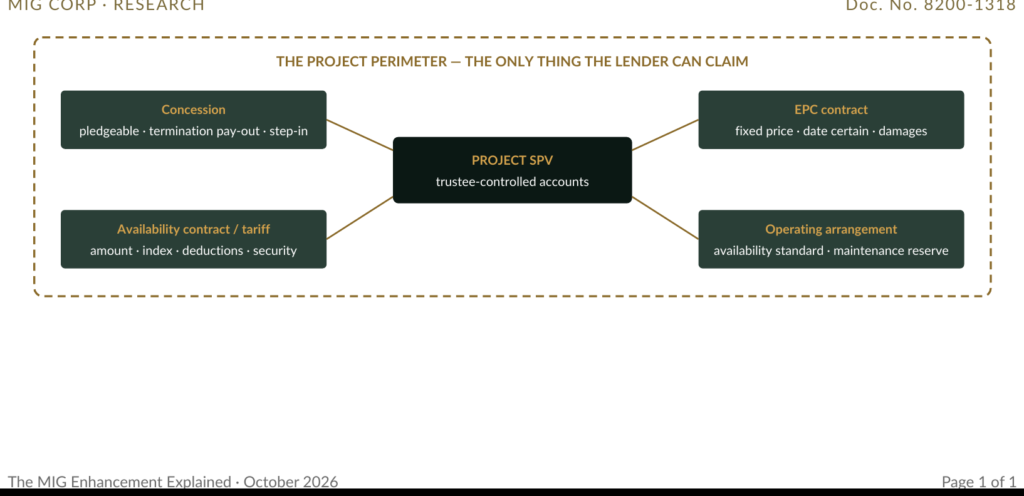
A non-recourse lender’s security is the project perimeter. For a line, the perimeter is built from four documents, and if any one of them cannot be pledged or enforced, the line cannot carry the debt.
The concession. Granted by the state for a term, usually twenty to thirty years, it gives the right to build, own and operate the line and to collect the tariff. What we need to know: can it be assigned or pledged to the vehicle and the lender; what are the termination events and what does the state pay on termination; does the state pay out the debt if it terminates for its own reasons; and what step-in rights exist if the concessionaire defaults. A concession that cannot be pledged, or that ends without compensation, is not bankable on a non-recourse basis, whatever else is true.
The availability contract or tariff regime. Whether it is a contract with the utility or a regulated tariff under the concession, we need from it what we need from any PPA: the amount and its indexation, the availability standard and the deduction regime, payment timing and security, late-payment interest, and the mechanics of any reset.
The construction contract. Fixed price, date certain, with a contractor whose balance sheet can actually pay liquidated damages for delay and under-performance. Rights of way and permits should be secured before financial close; if they are not, the contract price and schedule should carry contingency for them. A line whose route is not yet secured is a development risk, not a construction risk, and we do not finance development risk without recourse.
The operating arrangement. Lines are cheap to run but the availability standard is unforgiving. A contracted operator, or the sponsor under a service agreement with performance incentives, and a maintenance reserve sized to the inspection and replacement cycle.
3 · Carrying construction
Three tools do the work.
Contractor damages. Delay damages sized to cover debt service and fixed costs for the period of delay, up to a cap; performance damages if the line misses its availability standard at commissioning. Behind them, the contractor’s credit and a performance bond.
Contingency and an overrun facility. A budget with a contingency line and a committed source of funds, sponsor equity or a standby facility, if it is exceeded. Non-recourse lenders do not fund overruns. The sponsor does, in advance, through an undertaking signed at close.
Delayed draw. Debt is drawn as construction progresses, against milestones certified by an independent engineer, through the trustee. Interest during construction comes out of the budget. If construction is late, drawings stop and the overrun undertaking is called. The lender is never ahead of the asset.
In our structure the sponsor’s 10%, in cash or in kind (land, rights of way already secured, works already done), goes in before the first drawing. Equity and in-kind first, debt as the asset is built, the last drawing when the line is nearly commissioned. If something goes wrong halfway, the lender has funded half of an asset that is more than half built. Sequence is protection.
4 · Sizing against availability
Once commissioned, the line’s cash is the availability payment net of deductions, operating costs, the maintenance reserve, concession fees, insurance and tax: the stream we value in How to discount a transmission line. Debt is sized against it with a coverage ratio that reflects the absence of dispatch risk, a tenor inside the concession with a tail, and a repayment profile that follows the indexed tariff.
| Case | Availability | Indexation | Reset | Counterparty payment | What the lender needs |
|---|---|---|---|---|---|
| Base | At the contracted standard | Conservative long-run | As contracted | On time | Coverage at or above the floor |
| Downside | Below standard, deductions applied | Zero | Haircut | 90 days late | Coverage above one |
| Severe | Extended outage | Zero | Double haircut | 180 days late, reserves drawn | Debt-service reserve covers the gap |
The stresses are not a plant’s. There is no fuel case and no dispatch case. There is an availability case, a regulatory case and a payment-timing case, and the debt-service reserve is sized to the last of these, because a state utility that pays late is the most common form of stress a transmission lender ever meets.
5 · Lending to the system
The availability payment is only as good as the entity paying it, and we look through the utility to what stands behind it.
Where the utility is state-owned and the state guarantees its obligations, explicitly through a ministry of finance guarantee or structurally through a regulatory regime that passes the tariff to consumers, the credit is sovereign-linked and the premium is the sovereign’s. Where the utility stands on its own, we need payment security: several months of tariff in escrow, a letter of credit, or an assignment of consumer receipts.
The reset is the other counterparty risk. A regulator that has reset tariffs fairly for twenty years is a different credit from one that has reset them for political reasons. We value the current tariff to the next reset at face and the period after it at a haircut that matches the regulator’s record, and size the debt so it services on the haircut.
How sovereign-linked offtake is structured, with guarantees, escrow and the debt extracted from the contract rather than from the state’s balance sheet, is the subject of the next paper, Sovereign offtakes.
6 · What our enhancement adds
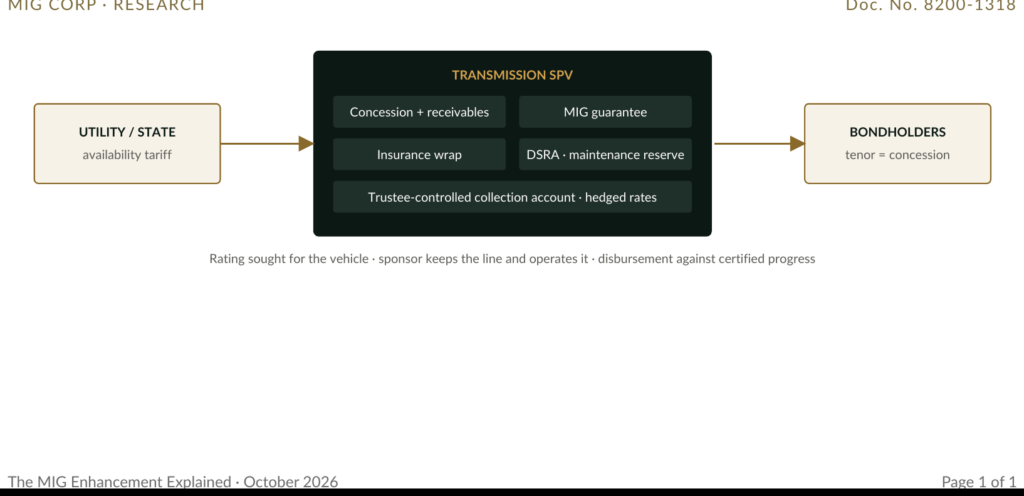
The line, the concession, the availability contract and the receivables go into a dedicated vehicle. Collateral is verified and sized by quality; for a line the concession rights and the receivables are the main collateral, topped up where needed by a bank instrument or the sponsor’s balance sheet. MIG provides a financial guarantee where the line’s own credit falls short, and an insurance wrap completes the enhancement; a line with a sovereign-guaranteed tariff and a good operating history may need only the wrap. Reserves, hedging and repo lines sit inside. The trustee runs the collection account. A rating is sought for the vehicle and the debt goes out as a bond with a tenor matched to the concession.
Two things come of this that a bank loan does not give. The tenor matches: a twenty-year concession gets twenty-year money, which bank balance sheets rarely provide. And the debt moves into the institutional market, where the counterparty premium on a sovereign-linked availability stream is priced off the Treasury curve rather than off a bank’s country limit.
7 · Getting out
A line in operation, with a sovereign-linked availability stream, inside a rated vehicle, is an asset institutions want. The sponsor can refinance at the lower rate operation justifies, or sell the contracted stream outright and put the capital into the next line. We have done both in Central America. The valuation is the one in How to discount a transmission line; the only difference is who keeps the tail.
Before we lend to a line we want to know whether the concession can be pledged and what the state pays on termination; whether the route is secured; whether the construction contract is fixed and the contractor can pay damages; who funds overruns; whether debt is drawn against certified progress; what the availability standard is and how the operator has performed; who pays the tariff and what stands behind them; what the reset regime is and whether the debt services on the haircut; whether the reserve is sized to late payment; and whether the tenor sits inside the concession with room to spare. Everything else follows.
MIG Corp publishes research on the structuring and financing of emerging-market infrastructure. Related papers: The MIG Enhancement Explained (8200-1318); When the power is late, who pays? (8200-1319); MIGCorp Bond one-pager (8200-1313); Financing AI Data-Centre Power (8200-1312); Floating LNG-to-Power for AI Data Centres (8200-1311). Further information on specific transactions is available under NDA from investments@mig-corp.com.
This paper is for information only and does not constitute an offer or solicitation. MIG International Ltd — RAK ICC Reg. No. A002/09/12/5254 — investments@mig-corp.com · mig-corp.com
The MIGCorp Bond™ is not a corporate bond of MIG International Ltd, is not a fund, and is not an offer of securities to the public. Each issuance is separately documented and separately rated, and is made available only to qualified institutional and professional counterparties. An investment-grade rating is sought for the issuing vehicle of each transaction; whether it is obtained, and at what level, depends on the structure, the credit profile and the agency’s own assessment. No rating is guaranteed. Worked examples are illustrative and do not describe any specific transaction or counterparty.
© 2026 MIG International Ltd. This paper may be quoted and shared with attribution and a link to mig-corp.com; it may not be sold or altered.