
Summary
We have been asked, more than once, why we like transmission lines so much. The honest answer is that they are boring in exactly the way a lender wants. A line under an availability concession is paid for being there, up and energised, whether it carries ten megawatts or a thousand. Demand risk, the thing that has sunk more infrastructure loans than anything else, is simply not in the contract.
That does not mean lines are easy to value. We have seen them priced like power plants, with a dispatch forecast nobody could justify, and we have seen them priced like toll roads, with a traffic study for an asset that has no traffic. Both leave money on the table, usually the sponsor’s.
What follows is how we do it. It comes out of the transmission and generation work we did in Central America between 2014 and 2019, and it has not changed much since: take the revenue apart, discount each piece at the rate it deserves, give the tail nothing, and then put the result into a structure the bond market will buy. The worked example is made up and describes no transaction.
1 · What a line is actually paid for
Before anything else, find out which of three revenue models the line sits under. They look alike on a term sheet and behave completely differently in a downturn.
The first and most common in our markets is regulated availability. The system operator or the national utility pays a tariff for the line being available to carry power, above an agreed standard, for the life of the concession. The tariff is set in the concession or by a regulatory formula, usually a return on a regulated asset base plus operating costs, indexed, and it runs for twenty to thirty years. Every line we have financed sat here.
The second is contracted wheeling: a generator or a large consumer pays the owner to move its power across the line, under a bilateral contract. Fine as far as it goes, but the money depends on the counterparty’s own project running. You are lending to the generator at one remove.
The third is merchant. The line earns the price difference between the two markets it joins. There are good merchant interconnectors in Europe. We have never financed one in an emerging market and do not expect to.
2 · Taking the revenue apart
The mistake we see most often is treating the contracted revenue as one number and discounting it at one rate. It is not one number. It is at least four, and they carry different risks.
The base availability payment is the fixed tariff, net of whatever deductions the contract allows for outages. This is the piece that gets the lowest discount rate, because the only things that can go wrong with it are operational or counterparty.
Indexation is worth a great deal over twenty years and is also a forecast rather than a promise. Tariffs are linked to a US inflation index, a local one, a currency basket, or some formula the regulator wrote in a different decade. We model it at a conservative long-run rate and treat anything above that as cushion. If the index outperforms, good; nobody was counting on it.
The regulatory reset cuts both ways. Where the tariff is re-based periodically against the asset base, the next reset can raise it or lower it, and the regulator’s history is the only guide. We value the tariff at face until the next reset and apply a haircut after it, sized to how that particular regulator has behaved.
The tail is everything after the debt is repaid, plus any residual or hand-back value at the end of the concession. It is real money and it is a long way off, and it depends on decisions nobody has made. In the financing case we give it little or nothing. The first contract has to repay the capital and a return on its own. That rule has saved us more than once.
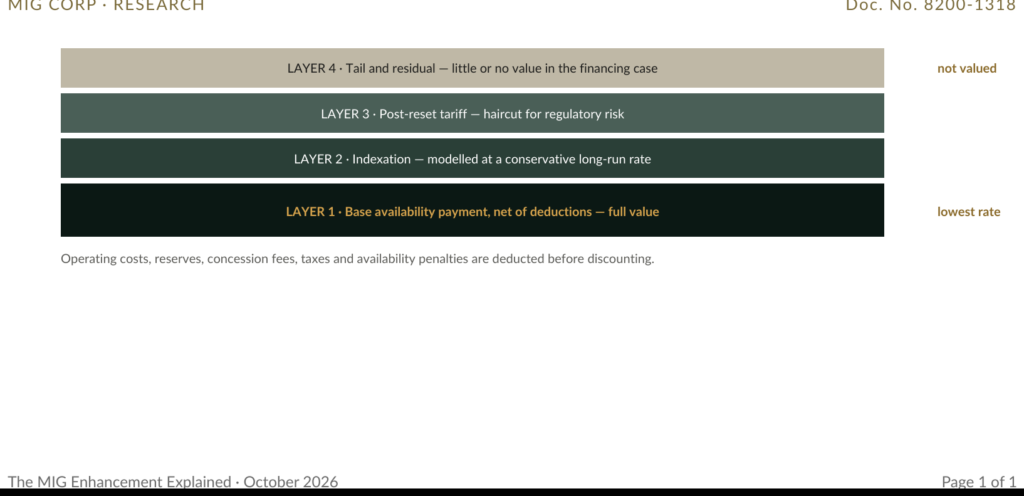
Costs come off before any of this is discounted: operation and maintenance, which for a line is mostly vegetation control, inspection, insurance and a small crew; a reserve for major maintenance; concession fees; taxes; and the availability penalty regime. The last is easy to underweight. A line that drops out for a month loses a month of revenue and may owe penalties on top, so the operator’s availability record is part of the credit, not a footnote to it.
3 · Which rate goes where
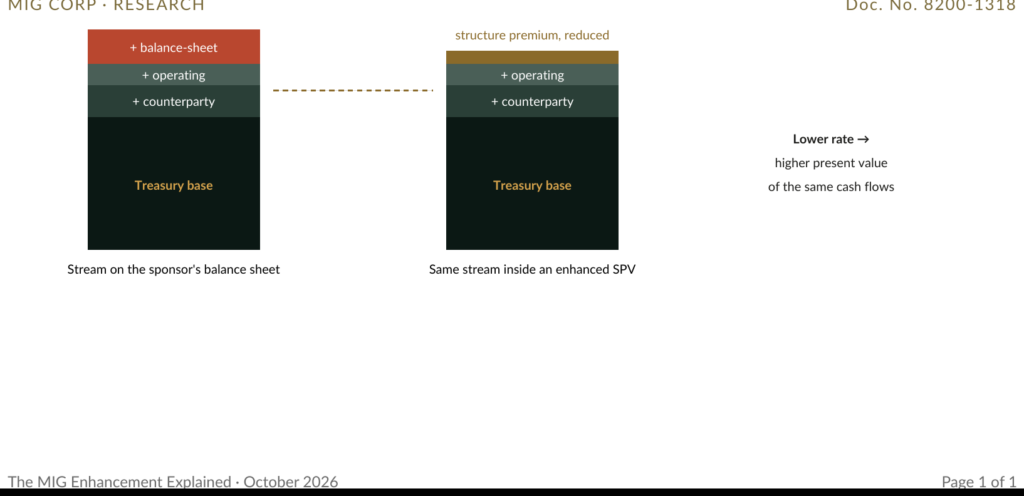
We build the discount rate the same way we build a bond coupon, from the bottom.
Start with the risk-free curve, meaning the US Treasury yield for the tenor of the cash flow. That is what any investor can earn by doing nothing.
Add a premium for whoever pays the tariff. If it is the national utility, the premium is the utility’s credit, which in a lot of countries means the sovereign’s, through ownership, guarantee or regulatory pass-through. If it is a private generator, the premium is the generator’s, and behind it the generator’s own offtaker.
Add something for operations. Small for a line in open country with a good operator; more for a line through mountains with a new one.
Then adjust for structure, and this is the part people miss. A tariff stream sitting on a sponsor’s balance sheet, mixed in with everything else the sponsor does, carries more risk than the identical stream inside a dedicated vehicle with a trustee, reserves, a guarantee and an insurance wrap. Same cash flows, different rate. Enhancement does not change what the line earns; it changes what the earnings are worth today.
4 · A worked illustration
Suppose a line under a twenty-five-year regulated availability concession, paid by the national utility, with twenty-three years left and three years of operating history at 99% availability. For the sake of the arithmetic, say the base payment is USD 30 million a year, indexed; costs and reserves run USD 5 million; we index at 2%; the regulator resets every five years and we haircut the post-reset tariff by 10%.
Net base cash is USD 25 million a year. We discount it at the counterparty-plus-operating rate up to the next reset, apply the haircut thereafter, include indexation at 2%, and give nothing to the years after twenty. What comes out is a single present value for a contracted, net, conservatively indexed stream.
| Step | What is included | How we treat it |
|---|---|---|
| Base availability payment | Tariff net of allowed deductions | Full value, counterparty rate |
| Costs | O&M, major maintenance, concession fee, insurance, tax | Deducted |
| Indexation | Contractual index | Conservative long-run rate |
| Regulatory reset | Years after the next reset | Haircut on tariff |
| Tail and residual | After the debt; hand-back | Little or nothing |
| Availability penalties | Contract regime | At the operator’s own record |
Then two tests. How much debt will that stream service at the structure’s coupon, with a coverage ratio that reflects there is no demand risk but there is still an operator? And does it still service if availability drops to 95%, indexation is zero, the reset haircut doubles and the utility pays late? If the answer to the second is yes, the structure holds. If not, less debt or more structure.
None of the numbers above belong to a real deal.
5 · From a value to a bond
Once the stream is valued, the rest is the MIGCorp Bond method we describe in The MIG Enhancement Explained. The concession rights, the availability contract and the receivables are assigned to a vehicle set up for that line and nothing else. The vehicle issues a bond sized to what the stream will service, with a tenor inside the concession, never beyond it. Collateral is verified; enhancement is sized to reach investment grade; the trustee runs the collection account, so the utility pays the vehicle and not the sponsor. Reserves bridge the gaps between tariff receipts. Rates are hedged. The penalty regime is covered by a maintenance reserve and the operator’s record.
Lines fit this unusually well, because the revenue is long, contracted, indexed and indifferent to demand. The question that remains is always the same: who pays, and what stands behind them. When the answer is a state utility, the next paper in this series, Sovereign offtakes, is about how we structure around it.
6 · Refinance or sell
A sponsor who has built a line and wants the capital back for the next one has two routes. One is the refinancing above. The other is to sell the contracted revenue outright, a true sale of future receivables to a vehicle that funds itself in the market. We have done both. The valuation is identical. What differs is who keeps the tail: sell the stream and you give up the residual and have nothing left to operate; refinance and you keep the line, the tail and the debt service. That is a strategic choice, not a technical one, and we have structured it either way depending on what the sponsor wanted to build next.
MIG Corp publishes research on the structuring and financing of emerging-market infrastructure. Related papers: The MIG Enhancement Explained (8200-1318); When the power is late, who pays? (8200-1319); MIGCorp Bond one-pager (8200-1313); Financing AI Data-Centre Power (8200-1312); Floating LNG-to-Power for AI Data Centres (8200-1311). Further information on specific transactions is available under NDA from investments@mig-corp.com.
This paper is for information only and does not constitute an offer or solicitation. MIG International Ltd — RAK ICC Reg. No. A002/09/12/5254 — investments@mig-corp.com · mig-corp.com
The MIGCorp Bond™ is not a corporate bond of MIG International Ltd, is not a fund, and is not an offer of securities to the public. Each issuance is separately documented and separately rated, and is made available only to qualified institutional and professional counterparties. An investment-grade rating is sought for the issuing vehicle of each transaction; whether it is obtained, and at what level, depends on the structure, the credit profile and the agency’s own assessment. No rating is guaranteed. Worked examples are illustrative and do not describe any specific transaction or counterparty.
© 2026 MIG International Ltd. This paper may be quoted and shared with attribution and a link to mig-corp.com; it may not be sold or altered.