
Summary
AI compute has turned into an energy problem before it has turned into a real-estate problem. A single hyperscale campus now asks the grid for more firm power than many utilities can connect inside five years, and it wants that power at a reliability most grids were never built to offer. Developers have responded by moving generation behind the meter and, more and more, to the coast, where fuel arrives by sea and the cooling water is free.
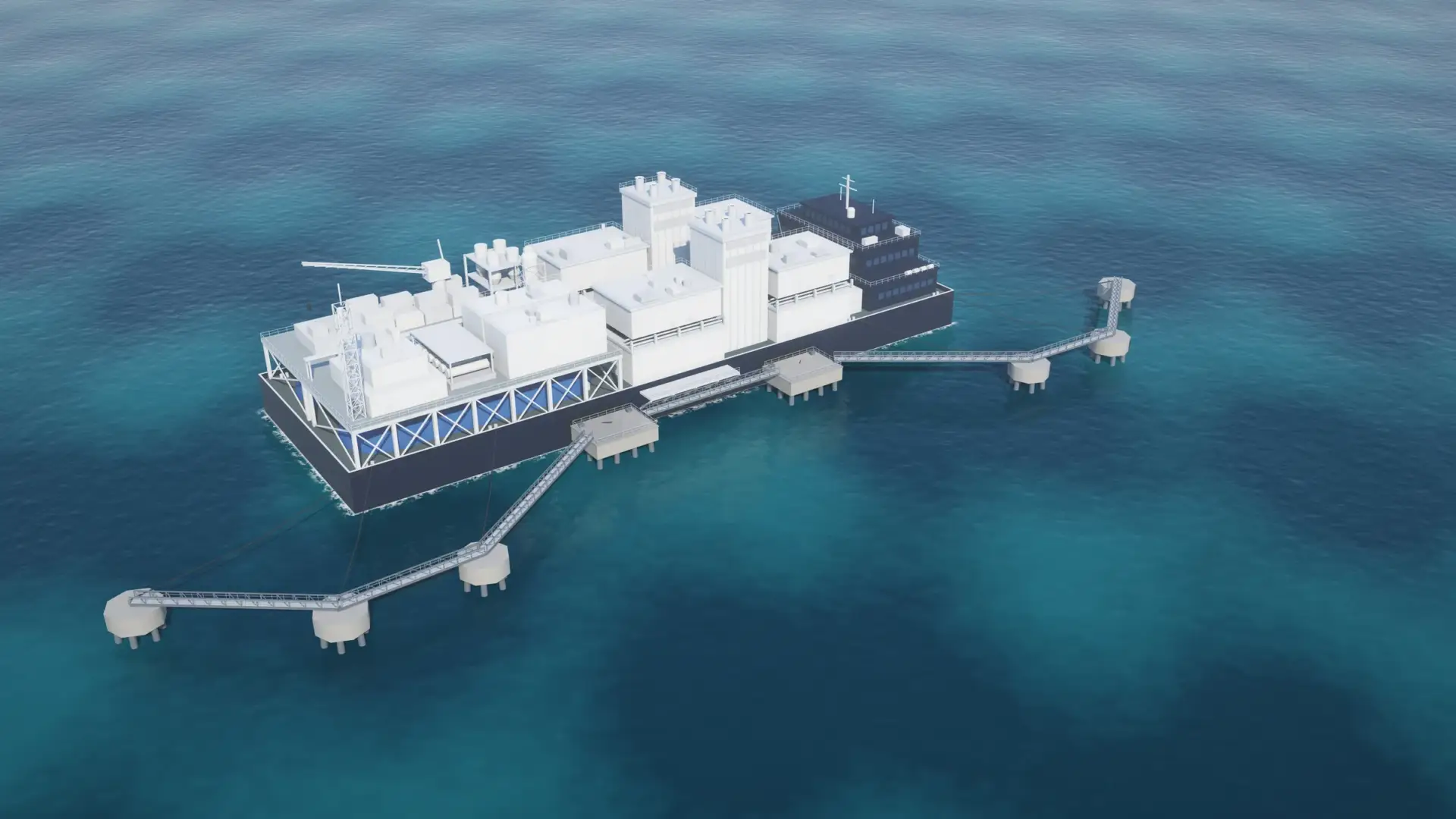
Blue Sea Power, a company in our portfolio, builds floating LNG-to-power plants: barges, built in a shipyard, that store LNG or bio-LNG, regasify it and generate electricity on board. They were designed to take oil-fired stations off islands and coastlines. The same platform turns out to be the natural power source for a data centre that needs no grid connection, no land and no freshwater, and together with Blue Sea Power we are now working on barge configurations built specifically for AI compute.
This paper sets out why we think floating LNG-to-power is the most bankable route to firm power for AI in the markets where the grid cannot keep up.
1 · Three constraints the grid cannot meet
AI training and inference clusters come in blocks of 50 to 150 megawatts of IT load, and each block has to run flat out, around the clock. In most of the markets we work in, Southern Europe, the Gulf, Africa, South-East Asia, the queue to connect a load that size runs three to seven years, and the grid that eventually arrives is often neither firm nor particularly clean.
Every megawatt of IT load has to be removed again as heat. Air-cooled halls in hot climates spend a third to a half of their energy on cooling. Liquid and immersion cooling cut that sharply but need a large, reliable heat sink. Inland sites compete for scarce freshwater. Coastal sites have the sea.
And a land campus is a civil-works project with its own critical path: permits, foundations, a substation, a transmission line. Hyperscalers and GPU-cloud operators are signing capacity years ahead of delivery and paying a premium for whichever site can energise first.
The usual answers, on-site turbines, battery farms, small reactors, each fix one of these. A floating plant on a berth addresses all three.
2 · What the plant is
A floating storage, regasification and power plant is a non-propelled barge, built in a yard and towed to site, that does the three steps of LNG-to-power on one hull. LNG or liquid biomethane, with hydrogen blending designed in, is delivered by carrier and held in cryogenic tanks on board. It is regasified on board, so no onshore plant is needed. High-efficiency gas engines then deliver power at medium voltage to a shore connection or straight to a load moored alongside. Blue Sea Power’s configurations run from roughly 50 to 200 megawatts.
None of this is new technology, which is the point. Floating storage and regasification units have been working since 2005 and are now an ordinary, charterable part of the LNG chain. Gas-fired power barges have run commercially for more than a decade. The engines, the containment and the ship-to-ship transfer systems all have a large installed base. What the plant does is put proven pieces on a single classed hull so that a complete power station leaves a shipyard rather than being built in a field. The FSRU market is the precedent worth remembering: a novelty in 2005, routine within ten years. Floating power is on the same path.
3 · Put the data centre next to the power
If the plant floats, so can the load. Moor a compute barge alongside a power barge at the same berth and the site has, from the first day, its own firm generation, its own fuel by sea, the sea as its heat sink, and a shore cable only for whatever it wants to export. Nothing on a land campus’s critical path, not the interconnection, not the substation, not the land assembly, not the water rights, applies.
| Floating AI site | Land campus, same IT load | |
|---|---|---|
| Grid connection | None; behind the meter | 100 MW-plus interconnection, multi-year queue |
| Land | A berth and a shore cable | 20–40 hectares plus a substation corridor |
| Cooling water | Seawater; no abstraction | Municipal or groundwater |
| Firm power | Own generation with redundancy, fuel on board | Grid plus diesel standby |
| Where it is built | A shipyard | On site, in the weather |
| Can it move? | Yes, under tow | No |
| Fuel | LNG or bio-LNG today; hydrogen blending ready | Grid mix plus diesel |
We and Blue Sea Power are working on configurations designed for AI compute: the power barge paired with a compute barge on a common hull design, built in the same yard, delivered to the same berth. We will say more as the work matures. The argument of this paper is about the architecture. One shipyard can deliver a complete AI site, generation, fuel, cooling and connectivity, in roughly the time a land campus spends in permitting.
4 · Why we think it is bankable
We look at a floating AI site the way we look at any project: can it be financed on its own cash flows, with institutional money, in a vehicle a rating agency will assess?
It has two contracted revenue streams on one asset. Power is sold under a capacity-backed PPA; compute is sold under colocation or GPU-as-a-service contracts with rated offtakers. The second stream does not depend on a grid tariff or a regulator; it depends on a market where capacity is sold years ahead. Where the host grid can take surplus, there is a third.
It is built in a yard against milestones, so construction risk is covered the way ship finance covers it, with refund guarantees on advances, performance bonds and delay damages from the yard, rather than with the softer completion guarantees of onshore EPC.
And it can be moved. If an offtaker fails, the barges go to another berth and another contract. A lender to a land-based data centre has no such remedy.
The financing is the structure we describe in Financing AI Data-Centre Power: a dedicated vehicle, a trustee-controlled collection account, the PPA and compute receivables assigned as security, and a rating sought at the vehicle level, independent of the sponsor.
5 · Where it goes first
Floating LNG-to-power was designed for the islands and coasts that still burn diesel and heavy fuel oil, and that is where it will replace them first. Blue Sea Power is developing deployments in Greece and looking at others across South-East Europe, the Mediterranean and the Middle East and North Africa. Each of those markets has the AI site’s constraints, no firm grid, scarce water, no time, and each can host a compute barge beside its power barge once the power is there.
Our view is a simple one. The AI build-out will go where firm, clean, fast power is, and in a growing number of places that power will float.
MIG Corp publishes research on the structuring and financing of emerging-market infrastructure. Related papers: The MIG Enhancement Explained (8200-1318); When the power is late, who pays? (8200-1319); MIGCorp Bond one-pager (8200-1313); Financing AI Data-Centre Power (8200-1312); Floating LNG-to-Power for AI Data Centres (8200-1311). Further information on specific transactions is available under NDA from investments@mig-corp.com.
This paper is for information only and does not constitute an offer or solicitation. MIG International Ltd — RAK ICC Reg. No. A002/09/12/5254 — investments@mig-corp.com · mig-corp.com · blueseapower.eu
The MIGCorp Bond™ is not a corporate bond of MIG International Ltd, is not a fund, and is not an offer of securities to the public. Each issuance is separately documented and separately rated, and is made available only to qualified institutional and professional counterparties. An investment-grade rating is sought for the issuing vehicle of each transaction; whether it is obtained, and at what level, depends on the structure, the credit profile and the agency’s own assessment. No rating is guaranteed. Worked examples are illustrative and do not describe any specific transaction or counterparty.
© 2026 MIG International Ltd. This paper may be quoted and shared with attribution and a link to mig-corp.com; it may not be sold or altered.