

Summary
When a bank decides that a book of loans is no longer worth its own time, it sells. The price it takes reflects what it costs the bank to keep holding, in capital, provisions, workout staff and regulatory attention, rather than what a hands-on owner can actually recover. We buy such portfolios from banks in North America at a deep discount to face value and work them out ourselves, loan by loan, with our own people in the files.
This note describes the practice: what gets bought, how it is priced, how it is worked, and why the return comes from our restructuring background and not from any financing trick. Figures, sellers and portfolio sizes are not disclosed.
1 · What is for sale, and why
Banks sell distressed portfolios for reasons that have little to do with the assets in them. Regulatory capital charged against non-performing loans is expensive. Provisions already taken make the accounting loss on a sale small or nil. A workout team is a cost centre, and a portfolio of hundreds of small positions eats more of it than a few large ones. And somebody in management wants the non-performing ratio down before the quarter closes.
What comes to market is mixed: commercial real-estate loans past maturity, small-business loans in default, equipment leases, secured and unsecured consumer paper, and sometimes the real assets themselves, properties taken in foreclosure, equipment repossessed. The common thread is that the seller has stopped doing the work, and the price says so.
2 · Pricing
We price loan by loan, never by portfolio average. For each position we want three things: what can be recovered, how long it will take, and what it will cost. Recovery is tested against the collateral, meaning an appraisal of the property, a valuation of the equipment, the borrower’s capacity to pay on a restructured schedule, and against the legal route: foreclosure timelines in that jurisdiction, lien priority, what other creditors are in the way. Time is discounted. Cost includes our own people, counsel, servicing, carrying costs on property, and tax.
The sum of the discounted net recoveries is what the portfolio is worth to us. The bid sits below it by the return we need for the risk, and the risk depends on how concentrated the book is, how much of the recovery turns on litigation rather than negotiation, and how much of the collateral we have been able to see. A portfolio where we have walked the properties and read the files gets a tighter bid than one bought from a data tape. That sounds obvious. It is also the reason we win some auctions and lose others on purpose.
| Step | What is done | Who does it |
|---|---|---|
| Data tape review | Every position classified: secured or unsecured, performing or defaulted, jurisdiction | Credit team |
| Collateral verification | Appraisals, site visits, title and lien searches | Our people and local counsel |
| Recovery estimate | Per position: amount, route, timeline, cost | Restructuring team |
| Portfolio value | Discounted net recoveries, summed | Credit team |
| Bid | Value less the return required for concentration, litigation and inspection risk | Investment committee |
3 · Working the book
This is where the money is made, and it is where our history matters. The firm began by buying, running and restructuring companies. The portfolio practice is the same habit applied to loans.
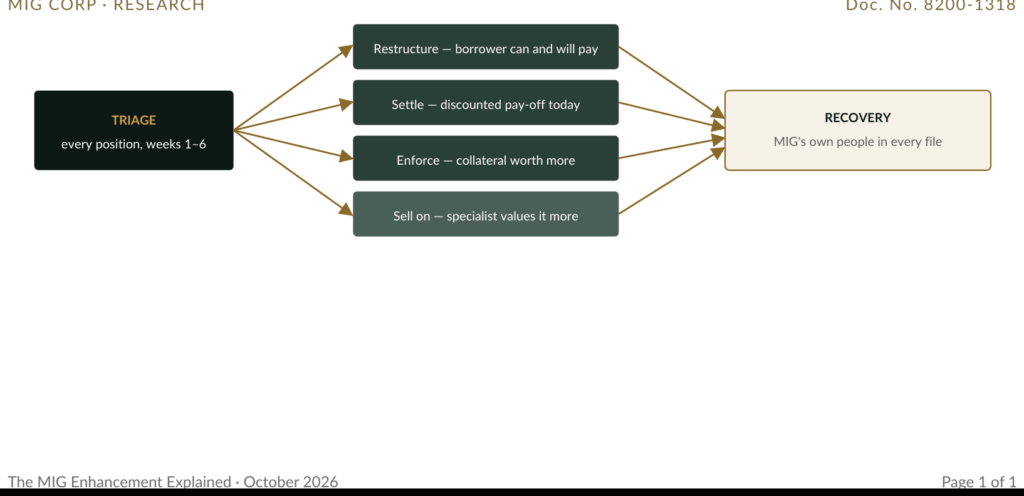
Within weeks of closing every position is given a route. Restructure, where the borrower can pay on a realistic schedule and wants to. Settle, where a discounted pay-off today beats a full recovery three years out. Enforce, where the collateral is worth more than the borrower’s cooperation. Sell on, where a specialist buyer values the position more than we do.
Most of the value comes back by agreement. Our people talk to borrowers directly, understand the business behind the loan, and write terms the borrower can actually meet: a longer tenor, a lower rate, some forgiveness against a lump sum now. Forcing a sale that destroys value for both sides is usually the lazy answer.
Where agreement fails we enforce. Foreclosure, repossession, sale. The legal route was priced when we bought, so the timeline is known and the cost is in the budget.
Property and equipment we end up owning gets managed, leased or improved before it is sold. A foreclosed building that has been stabilised and tenanted sells for more than one sold empty off the courthouse steps. Everyone knows this; fewer buyers have the people to do it.
4 · Why this is restructuring, not trading
A distressed-debt fund buys a portfolio and waits for the market. We buy a portfolio and work it. The difference is in who does the recovery: an outsourced servicer on a fee, or our own restructuring team with equity in the outcome. It is the same captive know-how we use on our own portfolio companies, origination, due diligence, creditor negotiation, operational turnaround, hands-on management, pointed at a book of loans instead of a single business. It is also the practice we now offer to third parties through our M&A and restructuring advisory.
5 · What it does for the rest of the firm
The portfolios are a North American business, outside our emerging-market verticals, and that is on purpose. They earn returns that have nothing to do with emerging-market infrastructure. They keep the restructuring team sharp between project financings. And they give us a current, practical read on credit in the deepest market in the world, the market whose Treasury curve is the base of every coupon we build.
Portfolio sizes, prices paid, sellers and recoveries are not disclosed. Further information is available under NDA from investments@mig-corp.com.
MIG Corp publishes research on the structuring and financing of emerging-market infrastructure. Related papers: The MIG Enhancement Explained (8200-1318); When the power is late, who pays? (8200-1319); MIGCorp Bond one-pager (8200-1313); Financing AI Data-Centre Power (8200-1312); Floating LNG-to-Power for AI Data Centres (8200-1311). Further information on specific transactions is available under NDA from investments@mig-corp.com.
This paper is for information only and does not constitute an offer or solicitation. MIG International Ltd — RAK ICC Reg. No. A002/09/12/5254 — investments@mig-corp.com · mig-corp.com
The MIGCorp Bond™ is not a corporate bond of MIG International Ltd, is not a fund, and is not an offer of securities to the public. Each issuance is separately documented and separately rated, and is made available only to qualified institutional and professional counterparties. An investment-grade rating is sought for the issuing vehicle of each transaction; whether it is obtained, and at what level, depends on the structure, the credit profile and the agency’s own assessment. No rating is guaranteed. Worked examples are illustrative and do not describe any specific transaction or counterparty.
© 2026 MIG International Ltd. This paper may be quoted and shared with attribution and a link to mig-corp.com; it may not be sold or altered.