

Summary
Aim Thai is a company we participate in, in Thailand. It grows a crop, processes it into snack products in its own factory, and sells them under its own brands into Thai retail and for export. Field, factory and shelf, under one roof. Of everything in our Agro vertical it is the clearest picture of what we mean by vertical integration, which is not owning farms but owning the chain, and of how we finance growth in a business we are inside: against the chain’s own cash flow, with our people in the company.
Financial figures are not disclosed.
1 · The company
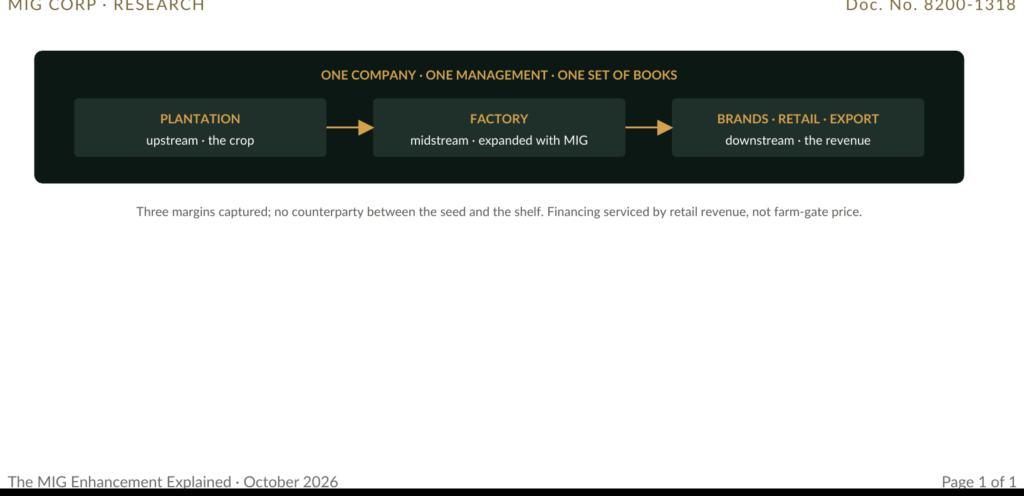
Most agricultural businesses occupy one link. The farmer sells to the mill, the mill to the trader, the trader to the brand, and every handover is a margin given up and a counterparty taken on. Aim Thai keeps all three links. Upstream, a plantation supplies the raw crop. In the middle, a factory turns it into packaged product. Downstream, the company’s brands carry it to retail and export customers. One management, one set of books.
The effect on the business is that it earns three margins per tonne instead of one. The effect on the credit, which is what interests us, is that the revenue that services financing is retail revenue, set by the company’s own sales, rather than a farm-gate price set by somebody else. A business that depends on nobody between the seed and the shelf is a business a lender can understand.
2 · What we do there
We are a participant in Aim Thai, not a lender to it. Our involvement is the usual mix of capital, operating work and finance.
We provided the financing that let the factory expand and raise its production capacity. The factory is the middle of the chain, where the value is made, and it was the constraint.
Our people work with the company’s management on the plan: capacity, product range, working capital, export markets. The habit of sitting inside a business rather than reviewing it from outside goes back to the firm’s origins in 2002 and has not changed.
The expansion was financed against the chain’s own cash, retail and export revenue rather than the value of the standing crop, with working-capital lines sized to the harvest cycle and growth capital sized to the new capacity.
3 · Why it is the template
Aim Thai is the shape we apply across the vertical.
In rice we hold long-term leased fields and manage milling under quota. Field, mill, bulk trade: the same chain with a bulk commodity at the end instead of a branded snack, and the same rule, control the upstream, manage the processing, contract the offtake.
In sugar we have been in the physical market since the firm’s early years, shipping several vessels of 15,000 to 50,000 tonnes through the year, and we hold cane plantations and allocations whose refinancing forms part of our offtake of the fields. We do not own sugar mills. We manage the relationship between the field, the mill and the market, and we finance it.
Corn and soya follow the same pattern: field, harvest, storage, offtake.
Greenhouses are the newest line, controlled-environment growing for markets where field agriculture is short of water or climate, financed as an integrated chain from the first season.
In every case the credit logic is Aim Thai’s. By holding the chain we turn a string of counterparty risks, the farmer who sells elsewhere, the mill that stops, the buyer who walks, into one operating risk that we manage ourselves. That is what makes agricultural cash flow bankable, and what allows it, in the right structure and at the right size, to be financed through the MIGCorp Bond against contracted offtake.
4 · What we look for
Sponsors with land rights and a farming record. Crops with a real physical market. The ability to contract offtake, or to build a brand. And a willingness to work inside an integrated chain rather than sell at the farm gate. In return we bring financing from planting to shipment, operating involvement where it is wanted, and the market access that comes from having traded these commodities for more than a decade.
Financial figures, shareholdings and facility sizes are not disclosed. Further information is available under NDA from investments@mig-corp.com.
MIG Corp publishes research on the structuring and financing of emerging-market infrastructure. Related papers: The MIG Enhancement Explained (8200-1318); When the power is late, who pays? (8200-1319); MIGCorp Bond one-pager (8200-1313); Financing AI Data-Centre Power (8200-1312); Floating LNG-to-Power for AI Data Centres (8200-1311). Further information on specific transactions is available under NDA from investments@mig-corp.com.
This paper is for information only and does not constitute an offer or solicitation. MIG International Ltd — RAK ICC Reg. No. A002/09/12/5254 — investments@mig-corp.com · mig-corp.com
The MIGCorp Bond™ is not a corporate bond of MIG International Ltd, is not a fund, and is not an offer of securities to the public. Each issuance is separately documented and separately rated, and is made available only to qualified institutional and professional counterparties. An investment-grade rating is sought for the issuing vehicle of each transaction; whether it is obtained, and at what level, depends on the structure, the credit profile and the agency’s own assessment. No rating is guaranteed. Worked examples are illustrative and do not describe any specific transaction or counterparty.
© 2026 MIG International Ltd. This paper may be quoted and shared with attribution and a link to mig-corp.com; it may not be sold or altered.